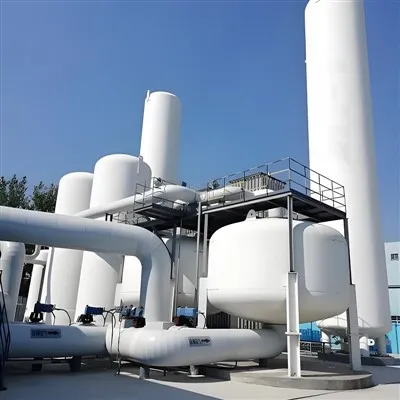
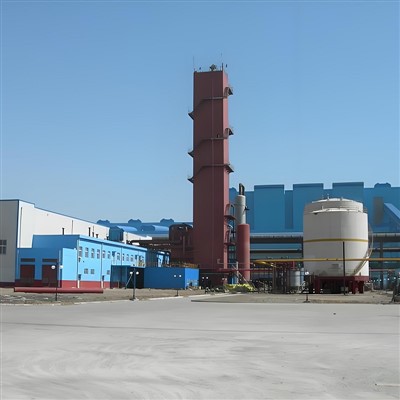
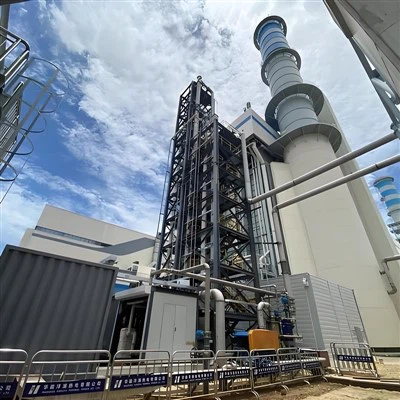
Small air separation unit uses air as raw material and adopts liquefaction distillation method to separate industrial gases such as oxygen, nitrogen, argon, etc. according to the difference in boiling points of different gases in the air. This device is usually composed of basic systems such as compression, purification, refrigeration, and distillation, and has many advantages. It adopts all-low-pressure process, room temperature molecular sieve adsorption combined with turbine expansion refrigeration, and PLC control, with stable and reliable performance. The product has high cost performance, high purity and low energy consumption, and can operate stably for a long time. The system components are modular and can be flexibly combined according to user needs. With ready-made design drawings and reasonable skid-mounted structure, the project cycle is greatly shortened.
Basic principles of air separation by cryogenic distillation
Distillation towers are tower-structured devices for direct gas-liquid contact used for distillation. There are mainly two types: packed towers and plate towers. Plate towers are equipped with multiple layers of plates, and there is a liquid layer of a certain height on the plates. The working principle of a packed tower is the same as that of a plate tower. The effect of a certain height of the packing layer is equal to that of a theoretical plate or a theoretical stage. The smaller the height of the equal plate (HETP), the better the mass transfer and separation effect of the packing layer. The distillation towers used in air separation units are usually two-stage distillation towers, namely the lower tower and the upper tower. The lower tower is usually a plate tower, and the upper tower is usually a packed tower. Now with the advancement of technology, the manufacturing cost of packed towers has dropped a lot; in addition, packed towers have the advantage of low pressure drop, which can reduce the outlet pressure of the compressor and thus reduce operating costs. Therefore, many lower towers of air separation units are now beginning to use packed towers. The air separation double-stage distillation tower pre-separates the air in the lower tower (high-pressure tower), first distilling it into pure nitrogen and oxygen-rich liquid air; then continue to distill in the upper tower (low-pressure tower), and finally obtain oxygen and nitrogen products. The condenser reboiler is the link between the upper and lower towers. It uses the medium-pressure nitrogen at the top of the lower tower to heat the liquid oxygen at the bottom of the upper tower (because the saturation temperature increases as the pressure increases, so the temperature of the medium-pressure nitrogen is higher than that of the low-pressure liquid oxygen), so that the nitrogen is condensed and the liquid oxygen is evaporated. The two-stage distillation tower has a higher product extraction rate and can simultaneously obtain double high products, namely high-purity nitrogen and high-purity oxygen.
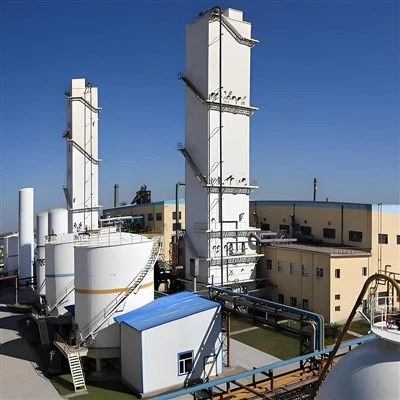


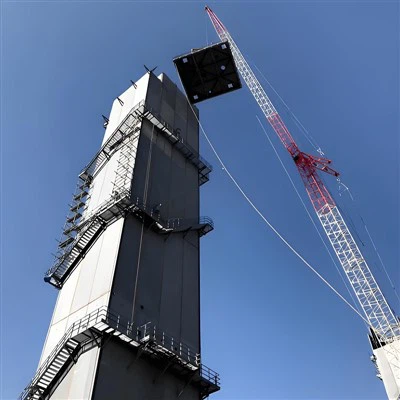
After the air in the atmosphere enters the compressor, it becomes compressed air. The compressed air passes through the air purification system to remove impurities such as moisture and carbon dioxide that will freeze and block the pipeline and heat exchanger channels, as well as hydrocarbons and nitrogen oxides that will cause explosion risks to the condenser reboiler connecting the upper and lower towers. Then it is cooled in the main heat exchanger into a gas-liquid mixed fluid and sent to the bottom of the lower tower of the distillation tower to become the rising gas of the lower tower. Because its oxygen content is 20.95%, its saturation temperature is 100.8K at an operating pressure of 0.6Mpa. The liquid nitrogen condensed in the condenser reboiler flows down from the top of the lower tower of the distillation tower as the reflux liquid of the lower tower. Because its oxygen content is generally below 1%, the corresponding saturation temperature at an operating pressure of 0.6MPa is 96.4K. From the saturation temperature, it can be seen that the rising gas in the lower tower of the distillation tower is higher than the temperature of the downstream liquid refluxed from the top of the tower. The rising gas in the lower tower will encounter a liquid with a lower temperature than it when passing through each tower plate during the rising process. After heat exchange, the temperature of the gas itself will decrease, and some of the gas will be continuously condensed into liquid. Since oxygen is a high-boiling component with a high condensation temperature, and nitrogen is a low-boiling component with a low condensation temperature, during the condensation process, more oxygen will be condensed than nitrogen, so the nitrogen concentration in the remaining gas will increase. This process is called partial condensation. After multiple partial condensations, most of the oxygen component in the gas is condensed, and finally the concentration of the nitrogen component in the gas can reach more than 99%. This part of nitrogen is introduced into the condenser reboiler, and condensed into liquid nitrogen after heat exchange with the liquid oxygen at the bottom of the upper tower of the distillation tower. Part of the liquid nitrogen is used as the reflux liquid of the lower tower, flowing from the top of the tower to the bottom, and the other part of the liquid nitrogen is used as the reflux liquid of the upper tower of the distillation tower. When the liquid nitrogen flows down, it encounters the higher temperature gas rising from the bottom of the tower. After exchanging heat, part of the liquid will be vaporized. Since nitrogen is a low-boiling point component and oxygen is a high-boiling point component, the low-boiling point nitrogen component is evaporated more, and the oxygen content in the remaining liquid increases. This process is called partial evaporation. In this way, partial evaporation is carried out again and again, and when the reflux liquid reaches the bottom of the lower tower, oxygen-rich liquid air with an oxygen content of 38%~40% can be obtained. Therefore, after multiple partial evaporation and partial condensation processes in the lower tower of the distillation tower, the air can be preliminarily separated into nitrogen with a nitrogen content of more than 99% and oxygen-rich liquid air with an oxygen content of 38%~40%.


The oxygen-rich liquid air is sent to the upper tower after throttling and pressure reduction, and used as a raw material for subsequent distillation. The upper tower distillation is similar to the lower tower distillation. After multiple partial evaporations in the liquid downstream, the nitrogen component evaporates more, and the oxygen content in the liquid continues to increase. When it reaches the bottom of the upper tower, pure liquid oxygen with an oxygen content of 99.0%~99.9% can be obtained. Part of the liquid oxygen at the bottom of the upper tower absorbs heat in the condenser reboiler and evaporates into gaseous oxygen, and the other part is taken out as product liquid oxygen and enters the storage tank. Under the operating pressure of 0.15MPa, the saturation temperature of this part of the evaporated gaseous oxygen is about 94.2K, which is used as the rising gas of the upper tower. During the ascent process, after multiple partial condensations, more oxygen components are condensed, so the nitrogen content in the rising gas continues to increase. After multiple condensations, the rising gas still contains more oxygen components. In order to reduce the loss of oxygen components, distillation should be carried out again. The liquid nitrogen drawn from the condenser reboiler has a content of more than 99%. The liquid nitrogen is throttled and subcooled and sent to the top of the upper tower as reflux liquid. The rising gas at the liquid air feed port and the reflux liquid at the top of the tower are partially condensed and partially evaporated several times. When it reaches the top of the upper tower, a pure nitrogen product with a nitrogen content of more than 99.99% can be obtained. The above is the process of separating air into nitrogen and oxygen in the distillation tower.



Hot Tags: small air separation plant, China small air separation plant manufacturers, suppliers, liquid oxygen gas plant, Air Separation Unit For Oxygen, Liquid Nitrogen Gas Plant, Cold Box Air Separation Unit, Co2 Manufacturing Plant, liquid air separation plant