Full analysis of the CO2 recovery plant: process, application and information required for cooperation
Driven by the dual carbon goals, the CO2 recovery plant uses advanced technology to realize the resource utilization of CO2 and promote the green transformation of the industry.
NEWTEK will introduce you in detail its core operating process, application areas, and key information you need to provide for cooperation.
The whole process of carbon dioxide recovery
Waste gas collection and pretreatment
The recycling plant collects industrial waste gas from power plants, chemical plants, steel plants, and other emission sources through a professional pipeline system. The waste gas first enters the pretreatment device to remove impurities such as dust, sulfide, nitrogen oxides, etc., creating conditions for subsequent efficient capture. For example, in the waste gas treatment of power plants, after dust removal, desulfurization,n and denitrification, the pollutant content in the waste gas can be greatly reduced to ensure that it meets the requirements of carbon dioxide capture.
Efficient capture
Advanced technologies such as chemical absorption, physical adsorption, and membrane separation are used to separate carbon dioxide from mixed gases. For example, the chemical absorption method uses amine solutions to react with carbon dioxide to achieve selective absorption of carbon dioxide, and the adsorption efficiency can reach more than 90%.
Deep purification
The captured carbon dioxide is subjected to multi-stage distillation, adsorption, and other treatments to increase its purity to 99%-99.99% to meet the needs of different application scenarios. For example, food-grade carbon dioxide needs to strictly controlled in terms of impurity content, and deep purification can make it meet food safety standards.
Storage and transportation
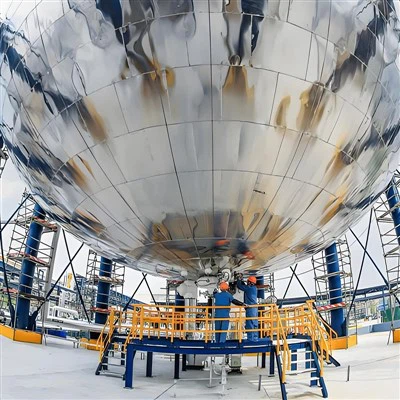
The purified liquid carbon dioxide is stored in a cryogenic storage tank and transported to the customer by a professional cryogenic tank truck or pipeline. The entire process is equipped with a real-time monitoring system to ensure transportation safety.
Resource utilization
According to customer needs, carbon dioxide can be used to produce degradable plastics, synthetic fuels, food preservation, oilfield flooding and production increase, etc., turning waste into treasure.
Diverse application areas
Industrial manufacturing
In the chemical industry, carbon dioxide can be used as a raw material to produce fertilizers such as urea and ammonium bicarbonate, as well as biodegradable plastics such as polycarbonate. When used in oilfield flooding operations, it can increase crude oil recovery by 10%-15%, helping energy companies reduce costs and increase efficiency.
Food and beverage industry
Food-grade carbon dioxide is widely used in the production of carbonated beverages and beer, giving the drinks a refreshing taste; it can also be used to preserve food, extend the shelf life of food, and ensure food safety.
Agricultural field
As a gas fertilizer, it can be used in greenhouses to increase crop yields by 20%-30%, while improving crop quality and helping the development of green agriculture.
Environmental protection field
Injection into underground saline aquifers or abandoned oil and gas fields for storage can achieve permanent carbon fixation of carbon dioxide, reduce the content of greenhouse gases in the atmosphere, and contribute to the response to climate change.
Information you need to provide for cooperation
To customize the most suitable carbon dioxide recovery solution, you need to provide the following key information:
Basic data of waste gas emissions
Including the source of waste gas (specific industries such as power plants and chemical plants), waste gas emissions (hourly/daily/monthly), and waste gas composition (carbon dioxide concentration, other impurity content, etc.). These data are important bases for designing the recovery process.
Site and facility conditions
Provide the site area, shape, surrounding environment, existing water and electricity supply, pipeline layout, and other infrastructure conditions that can be used to build the recovery equipment, to facilitate the evaluation of the feasibility of equipment installation and the construction plan.
Expected demand target
Clarify your expected carbon dioxide recovery volume, purity requirements, and production capacity planning for the next 3-5 years to help us design a forward-looking recovery system.
Special industry needs
If you belong to special industries such as food and chemicals, you need to inform the relevant industry standards and regulatory requirements so that we can ensure that the recovered carbon dioxide meets industry specifications.
Budget and Cooperation Model
Share your project budget range and desired cooperation model (such as equipment procurement, operation hosting, profit sharing, etc.) to promote efficient cooperation intentions between the two parties.
Hot Tags: co2 recovery and production plants, China co2 recovery and production plants manufacturers, suppliers, flue gas co2 capture and recovery system, Co2 Manufacturing Plant, ethanol production co2 capture plant, co2 recovery plant, enhanced oil recovery with co2 from recovery plant, carbon capture and storage (ccs) related co2 recovery plant