

The cryogenic air separation process is the most advanced and widely adopted method for producing high-purity oxygen, nitrogen, and argon in large industrial applications. From metallurgy and refining to chemicals and energy, countless industries rely on cryogenic Air Separation Units (ASUs) to supply stable, continuous, and cost-effective industrial gases. This article explains how cryogenic separation works and how engineering partners like NEWTEK provide fully integrated EPC and turnkey solutions that ensure safe, reliable, and long-term plant operation.
1. Why Cryogenic Air Separation?
Cryogenic technology is the only industrial method capable of delivering large-scale gas production with extremely high purity levels-up to 99.999% for nitrogen and equally high grades for oxygen and argon. It is ideal for steel plants, petrochemical complexes, synthetic fiber production, semiconductor manufacturing, and other industries where gas quality and volume are mission-critical.
Unlike membrane or PSA systems, which are optimized for moderate purity and flexible output, cryogenic ASUs are designed for continuous operations, stable performance, and efficient long-term energy utilization. This makes them the backbone of modern heavy industry.
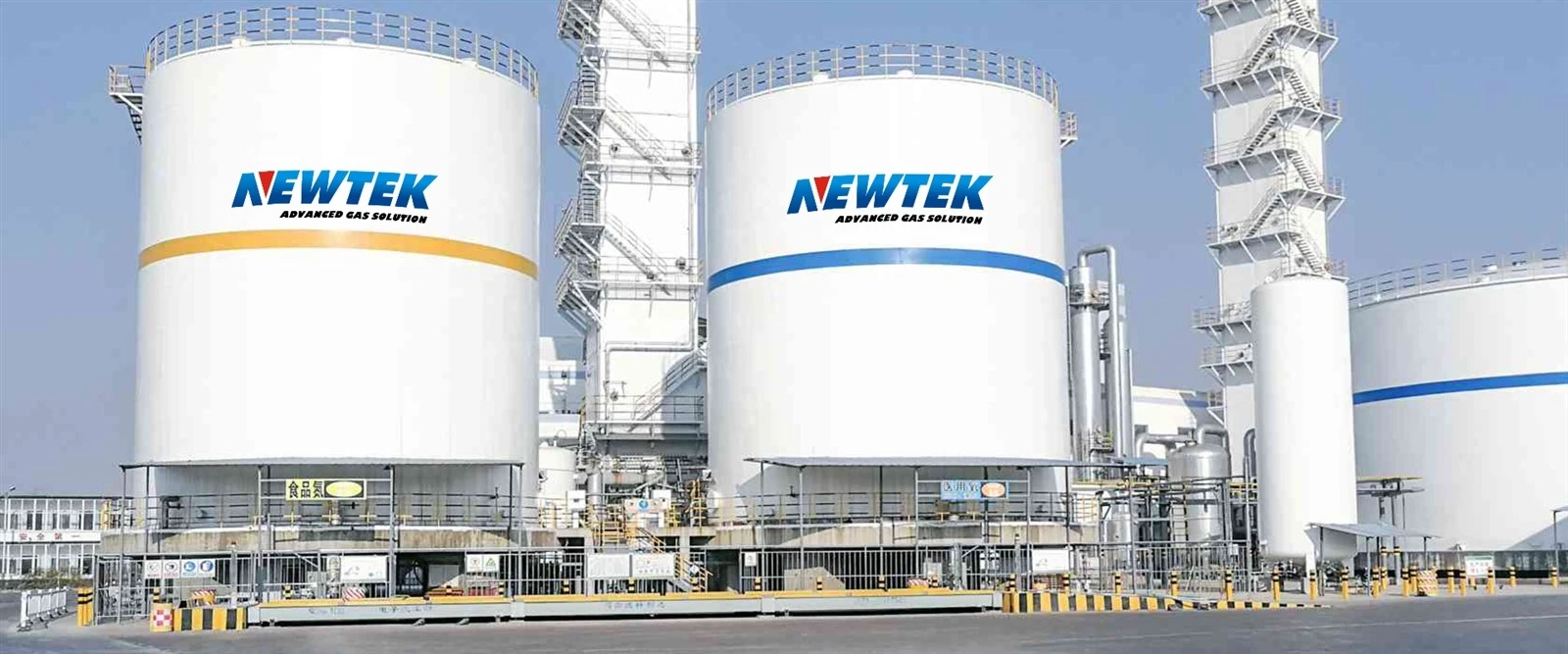
2. Step-by-Step Cryogenic Air Separation Process
2.1 Air Compression & Pre-Purification
The process begins by compressing atmospheric air and removing moisture, CO₂, hydrocarbons, and other impurities through molecular sieve adsorbers. This step is essential-any traces of water or CO₂ would freeze at cryogenic temperatures and block the system.
2.2 Cooling the Air to Cryogenic Temperature
Purified air is fed into a multi-stream plate-fin heat exchanger, where it is gradually cooled to around −180°C to −196°C using counter-flow heat exchange. As the temperature drops, the air mixture partially liquefies.
2.3 Fractional Distillation in the Cold Box
The liquified air enters a distillation column system inside the cold box. Because nitrogen, oxygen, and argon have different boiling points, they separate naturally:
Nitrogen (boiling point −196°C) evaporates first and rises to the top.
Oxygen (boiling point −183°C) remains in liquid form at lower tower sections.
Argon (boiling point −186°C), located between nitrogen and oxygen, requires an additional argon side column for purification.
Through continuous reflux and distillation, each gas reaches the desired purity.
2.4 Final Purification & Delivery
The separated gases are delivered as:
Gaseous oxygen/nitrogen for pipelines
Liquid oxygen/nitrogen/argon (LOX/LIN/LAR) for storage tanks or transportation
Optional booster compressors for high-pressure applications
This multi-stage cryogenic process enables stable, high-volume production 24/7 with excellent purity control.
3. Industrial Applications of Cryogenic ASUs
Cryogenic ASUs are essential across multiple sectors:
Metallurgy: Oxygen for blast furnaces, basic oxygen furnaces (BOF), and oxy-fuel combustion
Chemicals & Refining: Nitrogen blanketing, oxidation reactions, hydrogen generation
Textiles: Oxygen and nitrogen for fiber manufacturing and chemical intermediates
Energy & Electronics: High-purity gases for LNG processing, semiconductors, photovoltaics
Medical & Environmental: Medical oxygen, environmental testing gas supplies
With rising global demand for energy-efficient gas production, cryogenic ASUs remain the industry standard for reliability and output.
4. NEWTEK – EPC & Turnkey Solutions From Design to Operation
Modern air separation projects are large, complex, and require strong coordination across engineering, equipment, utilities, and plant operations. NEWTEK provides full-scope EPC & turnkey solutions designed to eliminate complexity and reduce risk for the customer.
4.1 All-in-One Engineering, Procurement & Construction (EPC)
Leveraging extensive expertise in gas engineering and resource integration, NEWTEK offers:
Front-end engineering and process design
System integration across compressors, turbines, cold box, and control systems
Procurement of key equipment from trusted global suppliers
Plant construction, installation, and commissioning
Performance testing and operational optimization
Our holistic EPC approach ensures that every subsystem is fully aligned, removing communication gaps and reducing interface conflicts.
4.2 Turnkey Delivery for a Worry-Free Experience
NEWTEK manages the entire lifecycle-from project initiation to stable operation-providing:
Streamlined project coordination
On-time delivery of new ASU facilities
Full startup support and operator training
Long-term operational reliability
A single point of responsibility
This enables clients to achieve immediate productivity while minimizing risk, downtime, and uncertainty.
5. Why Industries Choose NEWTEK
Deep expertise in cryogenic ASU design and industrial gas engineering
Integrated EPC capability, reducing delays and cost overruns
Turnkey delivery, ensuring the plant runs reliably from day one
Cross-industry experience in metallurgy, textiles, chemicals, refining, and energy
A one-stop solution that provides efficiency, professionalism, and long-term peace of mind
Whether expanding oxygen capacity, building a new nitrogen base load plant, or integrating gas supply into a refinery or steel complex, NEWTEK provides a reliable path from concept to operation.
Conclusion
The cryogenic air separation process remains the most advanced and efficient method for producing high-purity oxygen, nitrogen, and argon. As industries demand higher volumes and stricter purity control, cryogenic ASUs continue to play a central role in global industrial development. With comprehensive EPC & turnkey services, NEWTEK empowers customers to deploy robust, energy-efficient, and long-life ASU systems while eliminating coordination challenges and operational risks. From design to operation, NEWTEK delivers a truly integrated, one-stop solution for industrial gas projects worldwide.


