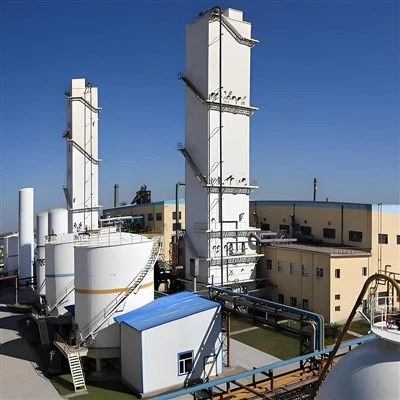
liquid Nitrogen Production Unit Key Benefits
Cost-Effectiveness and Long-Term Savings
On-site liquid nitrogen production eliminates the recurring costs of purchasing, transporting, and storing bulk liquid nitrogen or high-pressure cylinders. For medium- to large-scale users (e.g., manufacturing plants, hospitals), the plant typically achieves a return on investment within 12 months.
Uninterrupted Supply and Purity Control
Ambient air is an inexhaustible resource, ensuring a continuous supply of nitrogen even during supply chain disruptions (e.g., shipping delays, regional shortages).
Energy Efficiency and Environmental Sustainability
Modern liquid nitrogen production plants integrate energy-saving technologies to minimize their carbon footprint. Compared to traditional liquid nitrogen production facilities, which typically rely on fossil fuels, on-site electrically powered plants can be combined with renewable energy sources to reduce carbon emissions.
Flexibility and Scalability
These plants are designed to adapt to changing user needs. The modular design allows for easy expansion-users can add additional separation modules or upgrade the compressor to increase liquid nitrogen production as production or operational needs grow.
Typical Applications
Food Processing and Preservation
Liquid nitrogen is widely used in the food industry for rapid freezing (cryogenic freezing) and long-term preservation. This device produces liquid nitrogen on demand, ensuring perishable foods (such as meat, seafood, fruit, and baked goods) are continuously frozen at -196°C, preserving their texture, flavor, and nutritional value by minimizing ice crystal formation. Liquid nitrogen can also be used to quickly freeze ready-to-eat foods, extending their shelf life by 6-12 months. Furthermore, liquid nitrogen is used to cool food processing equipment (such as blenders and conveyor belts) and create an inert atmosphere in packaging (to prevent oxidation and microbial growth), thereby ensuring food safety and reducing waste.
Electronics and Semiconductor Manufacturing
The semiconductor industry requires ultra-high-purity nitrogen (99.99%) to create an inert environment during chip manufacturing. The liquid nitrogen provided by this unit is used to cool semiconductor wafers during etching, deposition, and packaging processes, preventing overheating and ensuring precision manufacturing. It also displaces oxygen and moisture in cleanrooms, reducing the risk of wafer contamination, which can lead to chip defects.
Chemical and Pharmaceutical Industries
In chemical manufacturing, liquid nitrogen creates an inert atmosphere (blanket) to prevent flammable or reactive chemicals (such as solvents, polymers, and explosives) from burning or oxidizing during production, storage, and transportation. Liquid nitrogen is also used for cryogenic grinding of materials (such as pharmaceuticals, plastics, and minerals) to reduce particle size without changing their chemical properties-critical for producing fine powders for pharmaceutical formulations or specialty chemicals.
Metallurgy and Manufacturing
In metallurgy, liquid nitrogen is used for heat treatment of metals and alloys (such as cryogenic hardening). By cooling metals to -196°C, this process increases their hardness, wear resistance, and fatigue strength, making it ideal for manufacturing tools, gears, and automotive parts. Liquid nitrogen also cools welding equipment and creates an inert atmosphere during welding processes (for example, welding stainless steel or aluminum), preventing oxidation and ensuring strong, high-quality welds.
Safe Storage and Handling of Liquid Nitrogen
Storage Tanks: Use only vacuum insulated (VIT) tanks designed for cryogenic liquids. Ensure tanks are located in a well-ventilated area (to prevent oxygen depletion) and away from heat, open flames, or flammable materials. Do not overfill tanks (follow the manufacturer's maximum fill guidelines, typically 80-90% of capacity) to allow for expansion of the liquid nitrogen.
Transfer Procedures: Use insulated hoses and connectors designed for cryogenic service to transfer liquid nitrogen. Avoid dropping or dragging hoses, as this can damage the insulation and cause the liquid nitrogen to evaporate rapidly. Always vent transferred liquid nitrogen slowly to prevent pressure spikes.
Avoiding Oxygen Depletion: When liquid nitrogen evaporates, it turns to nitrogen gas, which is colorless, odorless, and heavier than air. It can displace oxygen in confined spaces and cause asphyxiation. Install oxygen monitoring sensors in areas where liquid nitrogen is stored or used, and ensure that ventilation systems are functioning properly. If the oxygen level drops below 19.5% (normal air contains approximately 21%), immediately evacuate the area and ventilate until oxygen levels return to normal.
Our Products


FAQ
1.Can liquid nitrogen production equipment be customized to suit the site's space?
Yes, absolutely. To meet the needs of different customer layouts, floor height restrictions, or specialized installation scenarios (such as outdoor containerized or indoor compact installations), manufacturers can provide space-adaptive customization. This includes adjusting the overall equipment dimensions, optimizing piping routing, splitting modular components (e.g., installing the cold box and compressor unit separately), and even designing mobile containerized integrated equipment. This ensures the equipment precisely fits the site's space requirements without compromising liquid nitrogen production capacity and purity.
2. When customizing liquid nitrogen production equipment, what key parameters can be used to adjust production capacity and purity?
Two key parameters can be flexibly adjusted during the customization process:
Capacity Customization: Based on the customer's average daily/hourly liquid nitrogen demand (e.g., 50L/h, 500L/h, 10m³/d, etc.), we optimize the air separation system's compressor capacity, distillation column size, and heat exchanger area to ensure precise matching of production capacity to actual needs, avoiding wasted or insufficient capacity.
Purity Customization: The default purity is typically 99.99% (5N). If customers have higher requirements (e.g., 99.9999% (6N) ultra-high purity liquid nitrogen required by the electronics industry), this can be achieved by upgrading distillation column internals, adding an adsorption purification unit, or installing an online purity monitoring system. For applications such as food freezing, the purity range can also be adjusted to meet food-grade standards.
3. If the liquid nitrogen production equipment needs to be integrated with an existing air compressor system/storage tank, what parameters should be provided during customization?
To ensure interoperability, customers are required to provide the following key parameters:
Existing air compressor system parameters: air compressor exhaust volume (m³/min), exhaust pressure (MPa), outlet gas dew point (°C), and whether a drying and purification device is installed;
Existing storage tank parameters: tank capacity (m³), operating pressure (MPa), interface specifications (e.g., DN50/DN80 flange), and liquid level control method (e.g., float/pressure type);
Interoperation requirements: whether a buffer tank, automatic switching valve, or flow control system is required, and the desired linkage control logic (e.g., automatically activating nitrogen replenishment when the tank liquid level is low).
The manufacturer will optimize the equipment interface and control system based on these parameters to ensure seamless integration.
Hot Tags: liquid nitrogen production unit, China liquid nitrogen production unit manufacturers, suppliers, liquid nitrogen cooling equipment, liquid nitrogen dealer, liquid nitrogen guarantee, liquid nitrogen plant, liquid nitrogen production plant, liquid nitrogen representative