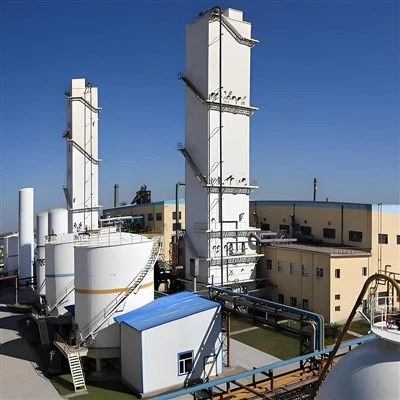
Engineering conditions
CO₂: ≤400 ppm
CH₄: ≤5 ppm
C₂H₂: ≤0.5 ppm
CnHm: ≤8 ppm
Mechanical impurities: ≤30 mg/m³
High voltage power supply: 10 kV ±5%, three-phase AC
Low voltage power supply: 380V/220V, three-phase four-wire system, center point directly grounded
Frequency: 60 ±0.5 Hz
Process
This air separation unit utilizes a molecular sieve purification + liquid air separation process, equipped with a booster expander and an air recycle booster. The lower tower is a sieve plate tower, and the upper tower is a structured packing tower. No argon is produced.
Feed air is filtered and dust-removed before entering the compressor. After compression and cooling, it is pre-cooled in a precooler before passing through a molecular sieve to remove impurities such as moisture, CO₂, and C₂H₂. Most of the purified air enters the main heat exchanger for cooling before entering the lower tower for rectification.
The lower tower produces liquid air and pure liquid nitrogen, which, after subcooling, enter the upper tower for further rectification, yielding liquid oxygen at the bottom and pure nitrogen at the top. Liquid oxygen and liquid nitrogen are output as products, with some nitrogen being reheated for molecular sieve regeneration.
FAQ
How does air gas separation work?
The system typically uses cryogenic distillation, pressure swing adsorption (PSA), or membrane technology to separate gases based on boiling points or molecular size differences.
What industries use air gas separation equipment?
Key industries include metallurgy, chemical processing, oil & gas, electronics, healthcare, food packaging, and glass manufacturing.
What is the difference between PSA and cryogenic air separation?
PSA is best for small- to medium-scale oxygen/nitrogen production and offers faster startup, while cryogenic air separation is ideal for large-scale, high-purity gas production.
Hot Tags: air gas separation equipment, China air gas separation equipment manufacturers, suppliers