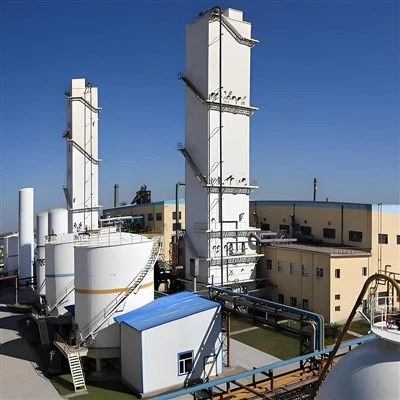
Excellent Gas Purity and Customization
This unit achieves industry-leading purity levels through two primary technologies: cryogenic distillation (suitable for large-scale, high-purity needs) and pressure swing adsorption (PSA) (suitable for medium-scale, flexible applications). For cryogenic systems, oxygen purities can reach up to 99.6% (v/v), nitrogen purities up to 99.9% (v/v), and argon purities up to 99.9999% (v/v). For PSA systems, purity can be adjusted between 90% and 99.99% based on specific needs, allowing companies to optimize gas quality without unnecessary energy consumption.
High Energy Efficiency, Low Operating Costs
Modern air separation units integrate energy-saving innovations to minimize operating costs. Key features include a heat integration system (recovering cold energy from the distillation process to pre-cool the incoming air), variable frequency drives for the compressors and fans (reducing electricity usage by 15-20% compared to fixed-speed models), and advanced insulation materials (reducing cooling losses in the cryogenic unit by up to 30%). These design elements deliver significant long-term cost savings: compared to purchasing bulk gas, on-site units reduce gas supply costs by an average of 30-50%, making them a cost-effective option for high-consumption industries.


Advanced Automation and Intelligent Control
The unit is equipped with a PLC (Programmable Logic Controller) or DCS (Distributed Control System), enabling fully automated operation from gas intake and compression to gas separation and storage. Operators can monitor real-time parameters (such as gas purity, pressure, temperature, and flow) through a user-friendly HMI (Human Machine Interface), set automatic alarms for abnormal conditions (such as high pressure in the distillation column), and remotely schedule maintenance tasks. This automation reduces human error (a major cause of downtime) and ensures stable 24/7 operation with an average availability of 98% or higher.
Rugged Safety Design
Safety is a top priority in the air separation industry, especially in cryogenic (liquid nitrogen temperature is -196°C) and high-pressure systems. The plant features numerous safety features: double-insulated cryogenic tanks to prevent heat intrusion and frost, pressure relief valves to relieve excess pressure to prevent explosion, gas leak detectors that trigger an alarm and automatically shut down upon leak detection, and emergency stop buttons accessible at critical operating points.
FAQ
1. What is an air separation unit?
An air separation unit (ASU) is a core industrial facility whose primary function is to separate atmospheric air into nitrogen and oxygen. Some units can also separate argon and other rare gases. Its core components include an air compressor (to increase air pressure), an air purification system (to remove impurities), a heat exchanger (to regulate temperature), a cryogenic cooling system (to liquefy the air), and a distillation column (to separate the gases). This unit provides high-purity gases to various industries and is an indispensable key piece of equipment in modern industrial production. Its production capacity and purity can be customized to meet specific needs, adapting to different scenarios.
2. How does an air separation unit work?
Air separation units primarily operate using cryogenic fractional distillation technology, a four-step process. First, compression: atmospheric air is drawn in and the compressor raises the pressure to 5-10 barg, improving subsequent efficiency. Next, purification removes impurities such as moisture and carbon dioxide from the compressed air to prevent freezing and clogging of the equipment. Cooling occurs: heat exchangers and refrigeration cycles cool the purified air to low temperatures, liquefying it. Finally, separation occurs: the liquefied air is fed into a distillation column, where the components are separated by utilizing the differences in boiling points of the gases (nitrogen - 196°C, oxygen - 183°C, and argon - 186°C).
3.What are the application areas of air separation units?
Air separation units have a wide range of applications: In the metallurgical industry, oxygen facilitates oxygen-enriched combustion and decarbonization in steelmaking, while nitrogen serves as a shielding gas to prevent oxidation. In the chemical industry, nitrogen is used for tank blanketing and pipeline purging, and oxygen participates in oxidation reactions. In the medical industry, high-purity oxygen is used for respiratory therapy and anesthesia, and nitrogen is used for cryopreservation of biological samples. In the food industry, nitrogen is used to extend shelf life through modified packaging and to assist in fermentation. In the electronics industry, ultra-high-purity argon gas supports semiconductor sputtering processes, and nitrogen is used for wafer cleaning, supporting core production processes across various industries.
Hot Tags: oxygen/nitrogen/argon air separation plant, China oxygen/nitrogen/argon air separation plant manufacturers, suppliers, air separation distributor, air separation manufacturer, gas separation maintenance, industrial gas production service, oxygen plant air separation unit, oxygen production contract