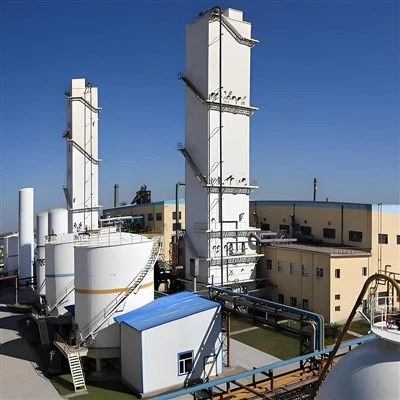
Air separation units (ASUs) play a crucial role in many areas of industrial production. With the growing demand for industrial gases, ASUs, with their reliability and efficiency, have become essential equipment for producing high-purity gases. Compared to other gas production methods, air separation processes are not only cost-effective but also scalable, leveraging economies of scale and reducing unit production costs.
Based on extensive experience in cryogenic engineering and a deep understanding of air separation unit design and construction, this article will provide a comprehensive guide to ASUs.
An air separation unit (ASU) is an industrial facility designed to separate atmospheric air into its primary components: nitrogen, oxygen, and, in certain circumstances, argon and other rare gases. A complete air separation unit typically consists of several key components, including an air compressor, air purification system, heat exchanger, cryogenic cooling system, and distillation column. These components work together to complete the complex process of air separation.
Air separation units can employ a variety of separation methods, with fractional distillation being the most widely used. Its core operating principle is to separate air through liquefaction and distillation. A typical operational flow is as follows:
Compression Phase: After atmospheric air is drawn into the ASU, it is pressurized by a series of compressors, typically controlled between 5 and 10 barg. This operation improves the efficiency of the subsequent cooling and separation processes, laying the foundation for the entire separation process.
Purification Phase: Before the compressed air is processed further, it undergoes purification to remove impurities such as moisture, carbon dioxide, and trace contaminants. This crucial step not only ensures the high purity of the final separated gas but also effectively prevents freezing or blockage of cryogenic equipment, ensuring stable operation of the unit.
Cooling Stage: The purified compressed air is cooled to a cryogenic temperature through a series of heat exchangers and refrigeration cycles. Since cryogenic distillation technology exploits the differences in boiling points between different gas components, this cooling process gradually liquefies the air, preparing it for subsequent separation.
Separation Stage: The cooled, liquefied air is fed into a distillation column (or series of columns). Different gas components have different boiling points: nitrogen boils at -196°C (or -321°F), oxygen boils at -183°C (or -297°F), and argon boils at -186°C (or -303°F). As the air rises within the distillation column, its temperature gradually increases, and each component vaporizes at its own boiling point. For example, oxygen-rich vapor rises to the top of the column, while nitrogen-rich liquid collects at the bottom. Argon, if present, is typically extracted as a by-product midway through the column. Collection, Storage, and Transportation: The separated gases are collected and stored in specialized tanks (pressure tanks or cryogenic tanks). These gases are then distributed and supplied to various industries based on varying purity requirements to meet their production needs.
Throughout its operation, the efficient operation of an air separation unit (ASU) relies on the close coordination of heat exchangers and separation columns, which together ensure the separation efficiency and stability of the unit.

Healthcare: The medical industry has a constant demand for oxygen and other technical gases. ASUs provide a stable, high-purity supply, supporting medical treatment and health preservation efforts.
Industrial Processes: In industrial production, ASUs are a key component of cryogenic technology applications, serving a wide range of processes, including metal manufacturing, chemical production, and wastewater treatment. They also produce high-purity gases for high-precision processes such as wafer fabrication and device manufacturing in the semiconductor industry, meeting the industry's stringent requirements.
Food and Beverages: Nitrogen, as a key component of "food gases," plays a critical role in the packaging and preservation of food and beverages. Nitrogen produced by ASUs effectively extends the shelf life of food and beverages, ensuring product quality.
Energy Production: ASUs can provide high-purity oxygen, which can be used in the combustion processes of power plants and steel mills, improving combustion efficiency and facilitating energy production.
Leveraging its deep expertise in gas engineering and robust resource integration capabilities, NEWTEK offers comprehensive EPC (engineering, procurement, and construction) and turnkey solutions for a variety of industries, including textiles, metallurgy, and chemicals.
We not only provide comprehensive EPC services, but also cover the entire process from project start-up to operations, creating a one-stop, worry-free service experience for our clients. When faced with large and complex industrial projects, NEWTEK effectively addresses communication, interface, and coordination issues, ensuring efficient and professional project execution, on-time delivery, and reliable operation, giving our clients peace of mind.