

The overall process flow of the NEWTEK GROUP 40000m/h air separation unit explains the impact of nitrogen plugging in the argon system of the air separation unit on the upstream and downstream processes, analyzes the root cause of nitrogen plugging in the argon system, formulates corresponding preventive measures, and optimizes the operation process to ensure the output and purity of the air separation unit.
Keywords: air separation unit; nitrogen plugging; operation process optimization
Content
2.1 Analysis of the causes of nitrogen plugging and treatment measures
2.3 Treatment measures after nitrogen plugging
3.Optimization of the operation process to prevent nitrogen plugging
1.what is Nitrogen plugging
Nitrogen plugging is a common fault in argon systems. In the crude argon tower condenser of the argon system, due to excessive nitrogen content in the crude argon fraction, a large amount of nitrogen will enter the crude argon condenser through the booster tower along with the crude argon fraction. Since the heat transfer temperature difference of the crude argon condenser is designed according to the content of the crude argon fraction, if a large amount of nitrogen entering the crude argon condenser cannot be condensed, it will gradually accumulate in the crude argon condenser, causing the heat exchange temperature difference of the crude argon condenser to become smaller and smaller, until no heat exchange occurs. The booster tower cannot wash the crude argon fraction without crude liquid argon as reflux liquid, and the argon fraction reflux liquid returning to the distillation tower will decrease, and the argon fraction extraction will also decrease. The rising gas flow in the crude argon tower will decrease, which will eventually lead to liquid leakage on the tower plate, deterioration of the distillation condition of the crude argon tower, and the formation of nitrogen plugging.


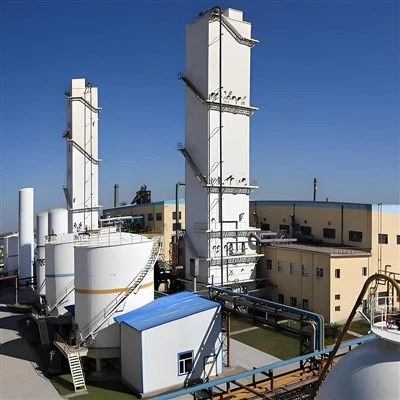
40000 m/h molecular sieve full-process jacket compression process air separation unit manufactured by NEWTEK. The unit is designed to produce 40000 m3/h of oxygen, 80000 m3/h of nitrogen, and 1500 m3/h of argon. It is currently one of the company's largest oxygen supply units, accounting for 17% of the total capacity. It is mainly responsible for the supply of gas sources for ironmaking, steelmaking, steel rolling and other power systems.
On May 22, 2023, the air separation unit had a nitrogen plug in the argon system. The argon content of the argon gas at the outlet of the crude argon tower was less than 92%, and the argon fraction flow rate dropped from the original 31000 m3/h to 13 000 m3/h. After the failure occurred, the operator effectively avoided fluctuations in the purity of oxygen and nitrogen by reducing the amount of oxygen (from 40000 m/h to 36000 m3/h), manually controlling the valve for liquid air to enter the crude argon condenser (to avoid large fluctuations in the argon fraction flow rate), and opening the crude argon vent valve.
At 15:10 on June 30, 2023, the argon content analysis table at the outlet of the crude argon II tower of the No. 9 air separation unit monitored that the purity of crude argon began to drop from 98.6%, and dropped to 97.06% at 15:38. At 16:12, the personnel on duty adjusted the purity of crude argon to normal purity (above 98.7%) through operation. The main reason for the nitrogen plugging this time: the argon fraction was controlled at 11%~12%, and the controlled argon fraction was high and lasted for a long time. The crude argon flow rate of 1550m/h is rare, and it should be controlled at around 1600m/h. The liquid air level of the crude argon condenser is 298mm, and the condenser has a large cooling capacity, which causes the argon fraction flow rate to increase, but the crude argon flow rate does not change. The nitrogen component in the argon fraction accumulates in the crude argon condenser until the crude argon condenser cannot work normally, and nitrogen plugging occurs. In response to these two failures, technicians considered whether it is possible to effectively control the nitrogen content entering the crude argon tower through optimized operations to prevent the occurrence of nitrogen plugging in the crude argon tower. However, after searching the relevant domestic literature, most of them are introductions to the operations after nitrogen plugging, and there are few studies on the prevention of nitrogen plugging. Therefore, it is necessary to conduct research on this work.
2.Process flow
After the raw air passes through a self-cleaning air filter to remove dust and mechanical impurities, it is compressed to about 0.48MPa by the integrated machine, washed and cooled by the pre-cooling system, and then enters the purification system to remove the remaining impurities (H2O, CO2, N2O and hydrocarbons, etc.) in the air. Then the air is divided into two paths, one enters the main heat exchanger, and enters the lower tower after heat exchange with the reflux dirty nitrogen, pure nitrogen, oxygen, and liquid argon; the other enters the upper tower after expansion and refrigeration by the expander. After continuous mass transfer and heat transfer, pure liquid oxygen is generated at the bottom of the upper tower and gas nitrogen is generated at the top.
A stream of argon fraction gas is drawn from an appropriate position at the bottom of the upper tower and sent to the crude argon I tower for distillation to reduce its oxygen content, and then the gas drawn from the top of the crude argon I tower is sent to the crude argon II tower for deep argon and oxygen separation. The top of the crude argon tower II is equipped with a condenser evaporator, which uses the liquid air drawn out from the subcooler as a cold source. Most of the crude argon gas can be used as the reflux liquid of the crude argon tower after being condensed by the condenser evaporator. The remaining part is distilled by the crude argon tower II. The crude argon gas with an oxygen content of <2x10⁶ is obtained at the top of the crude argon tower II and sent to the pure argon tower. High-purity refined liquid argon is obtained at the bottom of the pure argon tower and is drawn out of the cold box as the product liquid argon.
Oxygen is used as oxygen-enriched combustion in blast furnaces and oxygen for converter smelting; nitrogen is used as instrument power gas source and protective gas, and is also used for converter slag splashing, etc.; argon is mainly used for smelting high-demand varieties of steel. Liquid products are exported according to market conditions.

Figure 1 Simplified process flow diagram of the argon system of the air separation unit
2.1 Analysis of the causes of nitrogen plugging and treatment measures
The crude argon tower is divided into crude argon tower I and crude argon tower II. Crude argon tower I is for preliminary separation of oxygen and argon, and crude argon tower II is for final separation of oxygen and argon. The process flow chart of the argon system is shown in Figure 1. Most of the oxygen components in the gaseous argon fraction will be condensed during the rising process, while the low-boiling nitrogen components will not be condensed and will all remain in the crude argon, making the nitrogen content of the crude argon gas in the crude argon II tower several dozen times that of the nitrogen content in the argon fraction. If the nitrogen content in the argon fraction is too high, nitrogen plugging will occur in the argon system. When nitrogen plugging occurs, the discharge valve on the condensing side of the crude argon tower condenser should be opened in time to discharge the nitrogen components accumulated on the condensing side in time. If it is a slight nitrogen plugging, this operation can quickly restore the crude argon tower to normal.
2.2 Effect of nitrogen plug
First, when the nitrogen content in the crude argon II tower condenser increases, the heat exchange temperature difference in the crude argon II tower condenser will decrease, the heat load will decrease, the evaporation of liquid air will also decrease, and the amount of liquid air entering the crude argon II tower condenser will also decrease. The crude argon II tower condenser liquid air inlet valve will be closed, resulting in an increase in the amount of liquid air in the lower tower, an increase in the amount of liquid air going to the upper tower, and the upper tower liquid air throttle valve will be opened. The reflux ratio of the upper tower of the fractionation tower will increase, and the product oxygen purity will decrease.
Secondly, the amount of crude argon condensed in the crude argon II tower will decrease, the pressure in the tower will increase, the resistance will decrease, and the amount of argon fraction extracted from the upper tower of the fractionation tower will decrease, thereby increasing the rising gas volume above the argon fraction extraction port of the upper tower of the fractionation tower, reducing the reflux ratio, and reducing the purity of the product nitrogen.
Finally, since the crude argon II tower cannot work normally and the heat exchange effect deteriorates, the argon fraction flow entering the argon system will gradually decrease until it reaches zero, and the refined argon system will exit operation, causing the product liquid argon to decrease or stop producing. In severe cases, it will also cause abnormalities in the crude argon system and fluctuations in the operating conditions of the distillation tower, affecting the purity and output of the product oxygen and nitrogen.



2.3 Treatment measures after nitrogen plugging
There are three main treatment methods for nitrogen plugging caused by different reasons.
1) Reduce the oxygen extraction volume to 34,000~37,000 m3/h, then reduce the opening of the liquid air inlet regulating valve of the crude argon II tower condenser, reduce the argon fraction flow rate and the amount of nitrogen components in the argon fraction, and open the crude argon gas release valve. At this time, the opening size of each process valve is determined by the degree of nitrogen plugging, and attention should be paid to the purity of the product nitrogen. If the nitrogen quality does not meet the requirements, it needs to be withdrawn from the nitrogen pipeline network, and then the liquid system is started to supplement according to the main line production and the balance of the nitrogen pipeline network. After the argon system returns to normal, the nitrogen quality is adjusted.
2) Control the liquid air purity by adjusting the opening of the upper tower liquid nitrogen throttle valve. If the purity of liquid air is too low, it means that the reflux ratio of the lower tower of the fractionation tower increases, and the amount of liquid nitrogen flowing downstream is too much. It is necessary to open the upper tower liquid nitrogen throttle valve to send excess liquid nitrogen to the upper tower or liquid nitrogen storage tank, reduce the reflux ratio of the lower tower, and increase the purity of liquid air. After the purity of liquid air rises, due to the decrease in nitrogen component in liquid air, the heat load of the crude argon II tower condenser decreases at the same liquid air level. Therefore, it is necessary to open the opening of the liquid air inlet valve of the crude argon II tower condenser to ensure the extraction of argon fraction flow.
3) By reducing the liquid air level of the crude argon II tower condenser and reducing the heat load of the crude argon II tower condenser, it is possible to control the amount of argon fraction extraction and reduce the nitrogen component content entering the crude argon tower. Appropriately increasing the amount of crude argon flow can make the nitrogen component content in the crude argon tower be taken out more, thereby reducing the accumulation of nitrogen content in the crude argon tower. Reducing the amount of oxygen taken out and increasing the amount of nitrogen taken out can move the argon-rich area of the main tower upward, reduce the argon component content in the argon fraction, and reduce the nitrogen component content.
From the above analysis, it can be seen that the main reason for nitrogen plugging in the crude argon tower is that the nitrogen component content in the argon fraction entering the crude argon tower increases, causing the temperature difference of the crude argon II tower condenser to decrease, and the heat load to reduce until it cannot work. Therefore, reducing the nitrogen content entering the condenser is the technical key to improve this problem.
3 Optimization of the operation process to prevent nitrogen plugging
The No. 9 air separation unit indirectly monitors the nitrogen content in the crude argon gas by monitoring the argon content in the crude argon gas, and guides the personnel to operate. The main way for this large air separation unit to prevent nitrogen plugging in the crude argon tower is to adjust the opening of the liquid air inlet regulating valve of the crude argon II tower condenser according to the argon content in the argon fraction, so that the argon fraction flow rate and the crude argon amount match.
The working parameters for preventing nitrogen plugging in the crude argon tower are shown in Table 1.
| Table 1 Operating parameters for preventing nitrogen plugging in crude argon tower | |||
| Argon fraction Argon content/% | Liquid air regulating valve opening/% | Argon fraction flow rate/m³ | Crude argon volume/(m³/h) |
| 11.5~12.5 | 20.5~20.8 | 26000~29000 | 1700 |
| 11.5~12.5 | 20.3~20.6 | 25000~27000 | 1600 |
| 11.0~12.0 | 20.0~20.5 | 24000~26000 | 1500 |
| 10.5~11.0 | 19.5~20.0 | 22000~24000 | 1400 |
| 10.0~10.5 | 19.0~19.5 | 21000~23000 | 1300 |
| 10.0~10.5 | 18.5~19.0 | 20000~22000 | 1200 |
| 9.5~10.5 | 18.0~18.5 | 19000~21000 | 1100 |
| 9.0~10.0 | 17.5~18.0 | 18000~20000 | 1000 |
3.1 Operation method
1) In daily operation, if the argon content in the argon fraction exceeds the reference range, first adjust the opening of the lower tower liquid air throttle valve to increase the upper tower reflux ratio, and the argon fraction flow rate will be less than the reference value. Secondly, adjust the crude argon amount to be greater than the reference value. If the opening of the lower tower liquid air throttle valve exceeds the reference range, you can adjust the liquid air level of the crude argon II tower condenser to return the opening of the liquid air inlet valve of the crude argon II tower condenser to the normal reference range. If the crude argon amount exceeds the reference range, adjust the crude argon amount entering the liquefier to return the crude argon amount to the normal reference range.
2) To prevent excessive oxygen extraction from the product, an upper limit alarm value can be added to the product oxygen extraction in the DCS system. This value can be increased by 1000m3/h based on the operating value of the product oxygen output according to the working conditions of the shift. When the system alarms, the operator needs to determine the cause of the over-limit based on the working conditions, restore the product oxygen output to the original value in time, and appropriately reduce the opening of the liquid air inlet valve of the crude argon II tower condenser. After the argon fraction is normal, adjust the opening of the liquid air inlet valve of the crude argon II tower condenser back to the reference value.
3) When the purity of liquid air is too low, it is necessary to increase the opening of the upper tower liquid nitrogen throttle valve, adjust the liquid air purity, appropriately reduce the opening of the crude argon II tower condenser liquid air inlet valve, stabilize the argon fraction flow rate within the reference value range, and reduce the argon system load fluctuation.
4) Compared with the above operations, variable load operation is more complicated. Generally speaking, the expander system, main heat exchanger system, fractionation tower system and argon system designed for variable load operation of air separation unit are mostly liquid oxygen working conditions, which requires increasing the expansion volume, increasing the cooling capacity of the air separation unit, and converting the excess gaseous products into liquid products, but this process will cause changes in multiple parameters. The key factor affecting the load reduction operation is the upper tower liquid nitrogen throttle valve, which is a precision valve used to adjust the downstream liquid of the upper tower, and can also use the throttling effect for refrigeration. The valve accessories, including the valve body and the actuator, are imported, especially the positioner in the actuator is a key component, and its opening directly affects the main tower working condition, and then affects the purity of each medium product. Since the upper tower liquid nitrogen throttle valve is located near the top of the upper tower, part of the liquid nitrogen passing through the throttle valve is vaporized, further reducing the nitrogen temperature and providing part of the cooling capacity. Therefore, the upper tower liquid nitrogen throttle valve needs to be set as a high-sensitivity valve. When it changes from stable working conditions to other working conditions, the opening adjustment amount should not exceed 0.2° each time. If the valve adjustment exceeds 0.2°, the nitrogen purity will deteriorate. As the liquid nitrogen going to the upper tower decreases, the liquid nitrogen refluxed to the lower tower will increase. In addition, the air moisture content in the lower tower is large, and the purity of the liquid air will increase. In order to ensure the stable operation of the argon system, the opening of the crude argon II tower condenser liquid air inlet valve needs to be adjusted to be slightly less than the reference value. As the liquid oxygen output increases, the output of other product media will decrease.
3.2 Application Effect
Various gas products produced by air separation units are often vented in large quantities due to the valley period of gas consumption. If they cannot be adjusted in time according to changes in user demand, it will lead to an imbalance in the supply and demand of gas products and cause waste of resources. The downstream vaporization unit is affected by factors such as coal type switching, furnace reversal and load adjustment, and the oxygen consumption often changes. In order to maintain the stability of the pipeline pressure, the No. 9 air separation unit gives priority to the overall load change of the air separation unit and the load change operation of the argon system to meet the economic operation requirements under the unbalanced oxygen consumption of the main line unit. In the operation to prevent nitrogen plugging, the product purity and output did not fall below the standard. On the premise of meeting user needs, the excess liquid products can also be exported, which improves the independent operation capability.
4 Conclusion
Through the application and implementation of a series of optimized operation plans, NEWTEK air separation unit has achieved good results in preventing nitrogen plugging in the argon system, the crude argon tower of the argon system is working normally, the output and purity of oxygen, nitrogen and argon products are guaranteed, and the air separation unit operates smoothly, which has promoted the company's cost reduction, efficiency improvement and high-quality development.


