

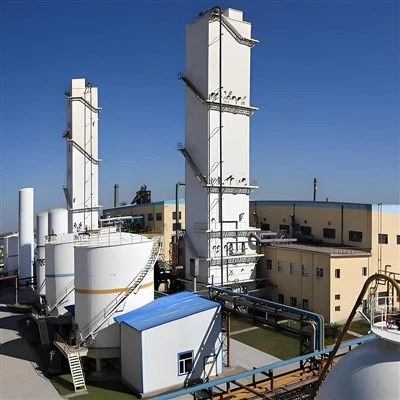
Large-scale air separation equipment is a key equipment widely used in metallurgy, petrochemical, coal chemical and other industries, providing oxygen, nitrogen and argon for the production process. As part of the production equipment of the customer enterprise, large-scale air separation equipment is related to the specific production activities of the enterprise. Therefore, the demand is generally determined according to the customer's own production conditions, and a customized production method is adopted.
Under the traditional customized production model, air separation equipment manufacturers often establish a special project team to carry out targeted design and production according to the specific requirements of specific customers and the characteristics of the customer to meet the product requirements of specific customers. This small-batch customized production model generally has two characteristics: ① Generally, product design and production are organized after obtaining customer needs; ② Usually, the customer sends a representative to the company to communicate specific needs through interviews and supervise the design and manufacturing process to ensure the consistency of the final product with customer needs. This production model works well when facing a small number of customer industries and has become the model adopted by most air separation equipment manufacturers.
Content Menu
1. The structure and demand status of large-scale air separation equipment
2. Overview of module construction and quality control technology
2.1 Quality control theory and method
2.2 Customer demand quality conversion technology
2.3 Modular design and module construction technology
2.4 Product module quality evaluation technology
3. Conclusion
1. The structure and demand status of large-scale air separation equipment
Air separation equipment uses air as raw material, and turns air into liquid through compression cycle deep freezing, and then gradually separates and produces inert gases such as oxygen, nitrogen and argon from liquid air through distillation .
Generally speaking, large-scale air separation equipment includes a series of basic subsystems, such as power system, purification system, refrigeration system, heat exchange system, distillation system, product transportation system, liquid storage system and control system.


Power system: Air separation equipment separates air into oxygen, nitrogen and other products through low temperature, which is essentially completed through energy conversion. The energy of the device is mainly input by the raw air compressor. Correspondingly, the vast majority of the total energy consumption required for air separation is the energy consumption of the raw air compressor.
Purification system: It consists of an air precooling system (air cooling system) and a molecular sieve purification system (purification system). The compressed raw air temperature is high. The air precooling system reduces the air temperature through contact heat exchange, and can wash harmful impurities such as acidic substances in it. The molecular sieve purification system further removes moisture, carbon dioxide, acetylene, propylene, propane and nitrous oxide in the air, which are harmful to the operation of the air separation equipment. Refrigeration system: The air separation equipment is refrigerated by expansion. The refrigeration of the entire air separation equipment strictly follows the classic refrigeration cycle. Therefore, the air separation refrigeration equipment usually mentioned mainly refers to the expander.
Heat exchange system: The heat balance of the air separation equipment is completed by the refrigeration system and the heat exchange system. The current heat exchange system mainly refers to the aluminum plate warp heat exchanger.
Distillation system: The core of the air separation equipment, an important equipment for realizing low-temperature separation. Usually adopts a high and low pressure two-stage distillation method, mainly composed of a low-pressure tower, a medium-pressure tower and a condenser evaporator.
Product delivery system: The oxygen and nitrogen produced by the air separation equipment require a certain pressure to meet the use of the subsequent system. The product delivery system is mainly composed of oxygen compressors and nitrogen compressors of various specifications.
Liquid storage system: The air separation equipment can produce a certain amount of liquid oxygen and liquid nitrogen and other products for use when needed. The liquid storage system is mainly composed of storage tanks of various specifications, cryogenic liquid pumps and vaporizers.
Control system: Large air separation equipment generally adopts computer distributed control systems to achieve automatic control.
The air separation equipment produced in my country has a wide variety of forms and types, including devices for producing gaseous oxygen and nitrogen, as well as devices for producing liquid oxygen and nitrogen. But in terms of basic processes, there are mainly four types: high pressure, medium pressure, high and low pressure and full low pressure processes. The production scale of air separation equipment in my country has developed from the early oxygen generator that could only produce 20m3/h (oxygen) to the current ability to produce super-large air separation equipment of 20,000 m3/h, 30,000 m3/h and 50,000 m3/h (oxygen). Some complex advanced products, such as high-efficiency turbine compressors, high-pressure multi-stage centrifugal cryogenic liquid pumps, high-pressure plate-fin heat exchangers, and high-efficiency medium- and high-pressure liquid-carrying turbine expanders, have been widely used.
The demand for air separation equipment in my country mainly comes from the steel industry, petrochemical industry, coal chemical industry and other chemical industries, power plant industry, etc. The steel industry is one of the largest users of oxygen, nitrogen and hydrogen³. The vigorous development of my country's steel industry has greatly promoted the development of air separation equipment. As one of the important auxiliary equipment of steel enterprises, the long-term stability and economic operation of air separation equipment are of great significance to steel enterprises. How to choose air separation equipment with reasonable economic configuration and safe and reliable operation is the goal pursued by steel enterprises. The petrochemical industry uses petroleum and natural gas as raw materials to produce gasoline, kerosene, diesel, lubricating oil and liquefied petroleum gas and other products. Air separation equipment is also one of the important auxiliary production units of oil refineries and chemical plants, mainly providing them with essential nitrogen and oxygen. At present, both the steel industry and the petrochemical industry have higher and higher requirements for air separation equipment. Coal chemical industry and some other industrial sectors have put forward higher requirements on the speed, efficiency and stability of air separation equipment.
2. Overview of module construction and quality control technology
The customers of large-scale air separation equipment are mostly industrial enterprises in complex environments. They have extremely high requirements for product quality and extremely complex requirements. Large-scale air separation equipment manufacturers can only survive in the fierce market competition by effectively controlling the quality of products throughout the life cycle. Since the quality characteristics of products are the detailed embodiment of quality, the quality control of products is concentrated in the constraints on quality characteristics, and the quality characteristics come from customer needs. Therefore, it is necessary to control the quality of large-scale air separation equipment. In order to control the quality of equipment, it is necessary to establish corresponding quality characteristics according to the specific customer needs.
In addition, for large air separation equipment enterprises, the main problem to be solved is the contradiction between the diversification of customer needs and cost and quality. Modular design is the most effective way to solve this contradiction. Modular design combines certain elements of the product to form a subsystem with specific functions. This subsystem is used as a universal module and combined with other product elements in various ways to form a new system to meet the different needs of the market. At present, the modular design of large air separation equipment faces a series of difficulties. Due to the large number of parts and components of large air separation equipment and the complex structure and functions, how to build modules under the premise of ensuring quality and how to evaluate the quality of modules are the difficulties to be solved in the modular design process of large air separation equipment.
2.1 Quality control theory and method
With the development of productivity and the improvement of industrial level, people pay more attention to product quality than ever before. Product quality has also become the focus of direct attention of customers and enterprises. It is one of the core competitiveness of enterprises and the key and foundation for the survival and development of enterprises.
The definition of quality in the ISO9000-2000 quality management system standard is: the degree to which a set of inherent characteristics meet the requirements . In this definition, inherent characteristics usually exist in a certain product and refer to the eternal characteristics of the product, such as the functional characteristics, performance parameters, and reliability of large air separation equipment. The requirements in the definition refer to the explicit or implicit needs or expectations that the product must meet, which mainly include two aspects. On the one hand, the product must meet the relevant laws and regulations, international or national standards, industry standards and rules, etc., and on the other hand, it is usually the needs of customers. The key to the concept of quality is "meeting requirements". These "requirements" must be transformed into characteristics with indicators as the basis for evaluation, inspection and assessment. The quality characteristics of a product refer to the inherent attributes of a product, process or system related to the "requirements".
The definition of "Quality Control (QC)" in ISO8402-1994 of the International Organization for Standardization is: the operating techniques and activities taken to achieve quality requirements. Among them, the "operating techniques and activities" include: determining the control object, formulating control standards, control methods, selecting inspection techniques, inspection operations, making control conclusions, and troubleshooting out-of-control to restore control.
The product life cycle is mainly divided into the following 10 stages: market research, product development, design, process design, procurement and supply, resource allocation, manufacturing, inspection, sales and after-sales service. These 10 stages are progressive and interconnected, forming a complete cycle of product life. Quality control activities run through every stage of the product life cycle. In order to meet the quality requirements of users and make the products applicable, enterprises should study the quality formation process in each stage according to product characteristics, enterprise scale and production methods, clarify quality standards, carry out necessary quality activities, and ensure that product quality is under control throughout the formation process. Large-scale air separation equipment is mainly aimed at industrial enterprises and has extremely high reliability and preventive control requirements. According to the survey, an abnormal shutdown of large-scale air separation equipment for one hour may cause direct economic losses of more than tens of millions to related enterprises. It can be seen that the quality control of large-scale air separation equipment is the most important part of its life cycle. However, due to the complex structure of large-scale air separation equipment and the changing customer needs, there are a series of difficulties in quality control. In general, there are the following aspects:

(1) Large-scale air separation equipment has extreme service conditions and complex working conditions. Its customer needs are difficult to predict and change. Therefore, the "requirements" in its quality concept are difficult to describe, that is, in the design and production activities of large-scale air separation equipment, its quality characteristics cannot be accurately and completely described.
(2) Modular design of large-scale air separation equipment is an important part of its design process. However, due to the large number of components, the strong electromechanical, hydraulic, gas and thermal coupling between related components, and the changing parameters, how to build modules and how to fully consider the quality characteristics of the product during the construction process is a blind spot in research.
In view of the difficulties in the above three aspects, this paper studies the product customer demand quality conversion technology, the module construction technology based on quality criteria, and the product module solution quality evaluation technology to solve the module construction and quality control problems in the modular design process of large air separation equipment.
2.2 Customer demand quality conversion technology
Quality is expressed in different forms such as demand reports, technical indicators, design documents, and processing routes at different stages of product development and production. In order to control the quality of products in different forms and determine the carrier of product quality, it is necessary to establish a unified description and expression form for the quality characteristics of the product. At the same time, the hierarchical, evolutionary and multidimensional characteristics of the quality characteristics as the carrier of product quality must also be fully valued in the quality description, so that the product quality information can be transmitted and mapped in the development and production process.
The development model of customized products is a user-centered rapid product development process. This development model is based on consumer demand, and consumer demand is the original driving force for product development in a certain period of time. Therefore, in the process of product design, consumer demand is the basis of product definition. Perfect and reasonable product definition must effectively transform customer voice into detailed description of product design and resource priority, so as to ensure the competitive advantage of products.
In the process of product development, customer demand must be clarified first. It is required to abstractly describe customer demand within a certain range according to certain rules and establish a customer demand model based on mass customization. Then, according to the similarity of customer demand, classify and establish groups, and establish corresponding product design clusters for different customer groups, so as to quickly meet diversified and personalized customer needs with minimal product deformation. At present, in terms of establishing customer demand models, there are mainly demand modeling methods based on demand information templates, structured demand modeling methods, demand modeling methods based on demand topology structures, and modeling methods based on physical elements.
2.3 Modular design and module construction technology
For large air separation equipment enterprises, the main problem to be solved is the contradiction between diversified customer demand and product cost. Modular design is one of the most effective ways to solve this contradiction. Modular design combines certain elements of a product to form a subsystem with specific functions. This subsystem is used as a universal module to be combined with other product elements in various ways to form a new system to meet different market needs. Specifically, the modular design method divides and designs a series of functional modules based on the functional analysis of products with different functions or the same functions, different performances, and different specifications within a certain range, and forms customized products for different customers through the selection and combination of modules.
2.4 Product module quality evaluation technology
After modular construction of large air separation equipment, many modular construction schemes will be generated. These schemes are retained because they have their own advantages under different evaluation criteria, forming a set of modular solutions for the product. The purpose of product modular design is to build the best product from existing modular solutions according to the personalized needs of customers. Module quality is a measure of the degree to which the modular construction solution meets customer needs. Obviously, only modular solutions with good module quality can take into account as many needs as possible, thereby forming a final product that satisfies all customers as much as possible. This objectively requires that the module quality must be evaluated.
3. Conclusion
This chapter first introduces the structural characteristics of large air separation equipment and the current situation of customer demand, then briefly explains the quality control theory and methods, and introduces the content and research status of customer demand quality conversion technology, modular construction technology and module quality evaluation technology.


