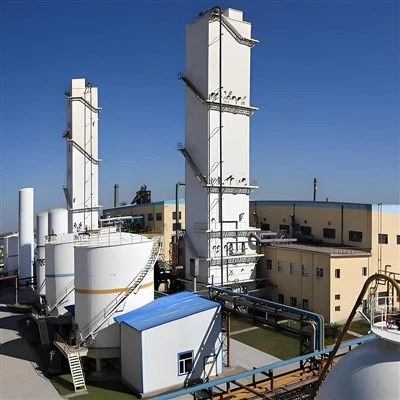
Process Flow and Features:
Air is first compressed and purified before entering the deep freezing stage. Through a multi-stage compression and expansion cooling cycle, the air is gradually cooled and liquefied.
This process provides a stable and efficient low-temperature environment for subsequent distillation, serving as the foundation for the entire separation process.
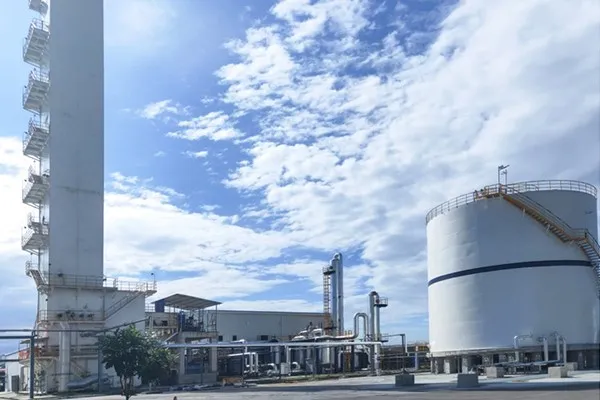
After entering the distillation tower, the liquid air is gradually separated by the temperature gradient within the tower, depending on the different boiling points of its components, such as oxygen, nitrogen, and argon.
After distillation, high-purity oxygen, nitrogen, and argon can be produced, reaching purities exceeding 99.999%, meeting the stringent requirements of industries such as electronics, medical, metallurgy, chemical engineering, and scientific research.
Air Separation Device Main Components:
The Air Separation Device consists of multiple key systems, each meticulously designed and optimized to ensure stable operation and high gas purity. Its main components include:
The Air Compression System
Comprising an air inlet filter, compressor, interstage cooler, and silencer.
This system compresses air to the required pressure while initially removing impurities, providing a stable air source for subsequent pre-cooling and purification processes.
The Air Pre-Cooling System
Includes a water-cooling tower, air-cooling tower, water pump, and chiller.
It lowers the compressed air temperature to an appropriate range, creating conditions for the molecular sieve purification system and deep freezing.
The Molecular Sieve Purification System
Uses a molecular sieve adsorber and nitrogen vent silencer.
It primarily removes moisture, carbon dioxide, and hydrocarbons from the air, preventing impurities from freezing at low temperatures and clogging pipes or damaging equipment.
The Heat Exchange System
Comprising a main heat exchanger and subcooler.
Utilizing the energy exchange between hot and cold gases, it further cools the air, improving overall energy efficiency. The distillation system includes core units such as distillation towers and condenser evaporators.
Through the distillation process, the components in the air are gradually separated based on their boiling point differences. High-purity nitrogen is produced at the top of the upper tower, high-purity oxygen is obtained at the bottom of the lower tower, and argon can be extracted in the middle.
The product delivery system is equipped with a pressure regulating station and a metering station.
This ensures that gas products are delivered to users at stable pressure and with precise metering, adapting to various industrial application scenarios.
The liquid storage and backup system consists of liquid storage tanks, gas storage tanks, and liquid evaporators.
This system provides users with reserve capacity and emergency support, ensuring a continuous supply of gas products during peak demand or equipment maintenance.
Purification Principles of Air Separation Units
In air separation units that utilize cryogenic distillation, air must undergo pretreatment processes such as filtration, precooling, and purification before entering the cold box for separation. This step is crucial because, if impurities in the air are not removed, stable operation and equipment life in low-temperature environments will be directly threatened.
1. The Importance of Air Filtration
Feed air contains a large amount of dust. If left untreated, this dust can cause wear, corrosion, and scaling on the impellers and blades during the high-speed operation of the air compressor, shortening the equipment's service life. Therefore, high-efficiency air filters are essential to remove suspended particulates and ensure initial air cleanliness.
2. The Necessity of Air Precooling
After compression by the turbine compressor, the air temperature can rise to over 80°C. This high temperature is not conducive to the subsequent molecular sieve adsorption and heat exchange processes. Air precooling systems (such as water cooling, air cooling, and refrigeration units) can effectively reduce the temperature, making the air more suitable for low-temperature processing when it enters the air separation unit.
3. Molecular Sieve Purification System
In addition to dust, air also contains moisture, carbon dioxide, and hydrocarbons (such as acetylene). These impurities easily freeze and deposit in low-temperature environments, potentially blocking air passages or damaging equipment. Modern air separation plants commonly use molecular sieve purification systems, which utilize adsorption to remove moisture and carbon dioxide, ensuring the cleanliness and stability of the air entering the cold box. This step not only improves separation efficiency but also significantly extends equipment life.
Air filtration, precooling, and purification are essential steps in air separation plants, providing a solid foundation for subsequent cryogenic distillation.
Can you customize air separation units (ASUs) to meet different gas requirements?
Yes. Our ASUs can tailor the output ratios to meet customer needs, for example, focusing on the production of high-purity oxygen, nitrogen, or argon. We will design a customized separation process and equipment configuration tailored to your industry application (such as steelmaking, chemicals, medical gases, or electronics manufacturing) to ensure efficient, stable, and compliant operation.
Can the ASU's automation and control system be customized to meet my requirements?
Yes. We offer advanced automation and control solutions and can configure a DCS/PLC system to fully automate the production process. The control system monitors key parameters such as temperature, pressure, purity, and flow in real time, supports remote monitoring and alarm functions, and ensures safe and controllable operation.
Can the ASU be customized to meet site conditions (such as climate, altitude, or energy mix)?
Of course. Our engineering team will conduct a comprehensive assessment of the site environment, including temperature, humidity, altitude, and power mix, during the initial design phase, and optimize the process flow and equipment structure accordingly. For example, in high-altitude areas, we adjust the compressor and heat exchanger parameters to ensure that the equipment can operate efficiently in special environments.
Hot Tags: air separation device, China air separation device manufacturers, suppliers, air separation exporter, air separation maintenance, gas separation negotiation, gas separation partnership, oxygen production exporter, oxygen production partnership