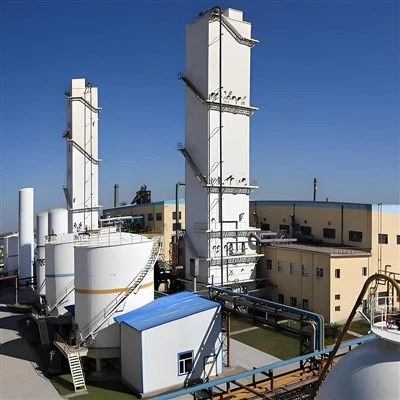
I. Core Technology Principles
The core of air oxygen generators is to utilize the differences in the physical properties of oxygen (approximately 21%), nitrogen (approximately 78%), and other trace gases in air to separate and purify oxygen through physical or chemical means. Mainstream technologies are based on different physical properties: Pressure Swing Adsorption (PSA) utilizes molecular sieves for selective adsorption, producing oxygen by adsorbing nitrogen under pressure and desorbing it under reduced pressure; Vacuum Pressure Swing Adsorption (VPSA) incorporates vacuum-assisted desorption into PSA; Membrane Separation utilizes the permeability selectivity of polymer membranes to rapidly transmit oxygen while retaining nitrogen; Cryogenic Separation compresses and cools air to below -183°C to liquefy it, then fractionates and separates the gases based on the boiling points of oxygen (-183°C) and nitrogen (-196°C) to produce oxygen of varying purities.
II. Product Types and Features
Air oxygen concentrators are categorized into four types based on their technology, suited to different scenarios. PSA equipment is compact, offers flexible start-up and shutdown options, and boasts an oxygen purity of 90%-95%. It is the mainstream small-scale oxygen concentrator for household and medical applications. VPSA equipment offers lower energy consumption and higher output, with a single unit producing 50-2000 Nm³/h of oxygen, with a maximum purity of 99.5%. It is primarily used in medium- and large-scale industrial applications. Membrane separation equipment has no moving parts and is easy to maintain, producing low-purity oxygen of 25%-40%, making it suitable for aquaculture and high-altitude oxygen supply. Cryogenic separation equipment offers high production capacity (tens of thousands of Nm³/h per unit) and can produce high-purity oxygen exceeding 99.99%. However, it requires high investment and has long start-up and shutdown cycles, making it primarily used in large industrial bases.

Application Scenarios

Steel and Metallurgy: Steel mills use VPSA oxygen generators to provide oxygen-enriched blast air for converters and blast furnaces, improving combustion efficiency and reducing coke consumption by 15%-20%, while also reducing nitrogen oxide emissions. A large steel company, after implementing a 2000 Nm³/h VPSA system, saw an 8% increase in annual production capacity and a 12% reduction in carbon emissions.

In the production of synthetic ammonia and methanol, high-purity oxygen (above 99.5%) can be used as an oxidant to improve reaction efficiency. In petroleum refining, oxygen-enriched combustion reduces energy consumption and lowers the sulfide content in exhaust gases. Cryogenic separation equipment is a key option for these applications.
FAQ
1. Can oxygen production equipment be customized to adapt to the low pressure and extreme temperature fluctuations in the plateau?
Taking into account the low pressure and large temperature swings between day and night and between seasons in the plateau, customization will focus on optimizing core technology, material selection, and functional design. Technically, the pressure regulation system of the pressure swing adsorption (PSA) equipment's adsorption tower will be improved. By adjusting the adsorption and desorption pressure parameters and optimizing the molecular sieve formulation (e.g., using specialized molecular sieves with high selectivity and low pressure resistance), the equipment will be able to efficiently separate oxygen and nitrogen and maintain stable oxygen production efficiency even in low-pressure environments above 5,000 meters. Regarding materials, the equipment housing and key internal components will be constructed from high- and low-temperature-resistant specialty alloys or engineering plastics (e.g., those with high- and low-temperature resistance). The device can withstand extreme temperature differences of 30°C to 50°C to avoid cracking and aging of components due to large temperature differences. At the same time, the outer shell will be coated with waterproof and dustproof coatings to adapt to the outdoor environment of the plateau with frequent wind, sand, rain and snow. In terms of functional design, the size and weight of the device can be customized according to the actual usage scenario (such as fixed use at plateau outposts and carried by exploration teams on foot). The portable version can be controlled within 3kg. It can also be equipped with a dual power supply mode (lithium battery + solar charging) to solve the problem of unstable power supply in some areas of the plateau, ensuring that the device can continue to produce oxygen even without an external power supply, meeting the daily oxygen inhalation or emergency oxygen supply needs of personnel.
Hot Tags: oxygen separation equipment in air, China oxygen separation equipment in air manufacturers, suppliers