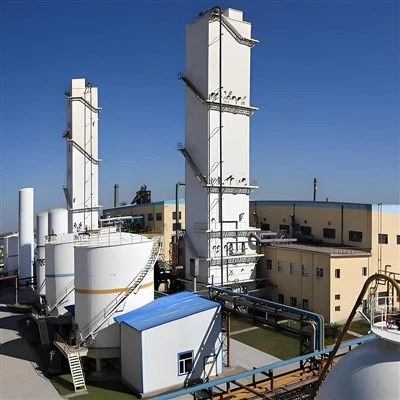
How Air Separation Units in Steel Manufacturing Work
1. Air Intake and Purification:
The ASU draws in atmospheric air, which is then compressed, cooled, and purified to remove impurities like water, carbon dioxide, and hydrocarbons using a molecular sieve system.
2. Cryogenic Separation:
The purified air is then fed into a cryogenic air separation section, where it is cooled to extremely low temperatures and liquefied.
3. Distillation:
The liquefied air undergoes fractional distillation, a process that separates it into its primary components: oxygen, nitrogen, and argon, based on their different boiling points.
4. Gas Production:
These high-purity gases can be supplied in either gaseous or liquid form, depending on the plant's and the steel mill's specific needs.
Role in Steelmaking
Oxygen for Combustion:
The most important application is providing oxygen for the Converter Oxygen Furnace (BOF). Oxygen is blown into the molten iron to oxidize impurities and produce steel. This process also produces high-purity oxygen for combustion.
Argon for Welding and Fabrication:
Argon is used in specialty welding and plays a vital role in other processes, preventing contamination and improving weld quality.
Nitrogen for Inerting:
High-purity nitrogen displaces oxygen in storage tanks and equipment, preventing unwanted oxidation reactions, and acts as an inert gas in various process steps.
Benefits for Steelmakers
Improved Efficiency:
ASUs improve the efficiency of steel production by providing a continuous and reliable source of pure oxygen and other gases.
Improved Product Quality:
High-purity gases help maintain consistent steel product quality.

FAQ
What are the causes of water ingress accidents involving molecular sieves in liquid air separation units?
To quickly address the core causes of water ingress accidents involving molecular sieves in liquid air separation units, I will examine key aspects such as the pretreatment system, operation and maintenance, and equipment failure. Using concise language, I will clarify each contributing factor to help quickly identify the problem. Common causes of water ingress into the molecular sieves of liquid air separation units include: 1. Malfunction of the air pretreatment system, such as damage to the pre-filter (primary/intermediate) or decreased filtration efficiency, allowing liquid water or high-humidity air to enter the molecular sieve adsorption tower directly; 2. Ineffectiveness of the air compressor aftercooler, which fails to reduce the compressed air temperature to below the dew point (usually ≤40°C), preventing adequate condensation and separation of water vapor, which then enters the molecular sieve with the airflow; 3. Clogged or damaged steam traps, preventing timely discharge of condensate from the bottom of the cooler or separator, leading to backflow or airflow into the molecular sieve; 4. Operational errors, such as failure to thoroughly purge water from pipes before startup or delayed valve activation when switching molecular sieve adsorption towers, leading to residual water ingress; 5. Aging and leaking seals in the molecular sieve adsorption tower, allowing humid air to infiltrate, or uneven airflow distribution within the tower, resulting in inadequate water adsorption in some areas.
Why is a high-high interlock required for the water level in the air-cooling tower of an air separation unit?
Air separation units (ASUs) have high-water-level interlocks to prevent excessively high cooling water levels from being carried into downstream systems (such as molecular sieves, heat exchangers, or compressors) by the airflow. This could cause equipment damage, process disruptions, or even production shutdowns. This protection mechanism automatically shuts off incoming liquid or adjusts process flow to ensure safe and stable system operation.
To prevent water from entering downstream systems and protect critical equipment, if the water level in the ASU is too high, cooling water could be carried by the high-speed airflow into the molecular sieve adsorber or switchable heat exchanger, causing water intrusion. Water could also be carried into the compressor inlet, causing compressor surge (severe airflow pulsation, mechanical vibration, and noise), and in severe cases, damage to compressor blades or shaft seals. Once water enters downstream systems, it could trigger a chain reaction, ultimately forcing the ASU to shut down and disrupting production continuity. To prevent pressure abnormalities from exacerbating water-level issues, when the pressure in the ASU is too low, the airflow velocity decreases, weakening the impact and entrainment on the liquid level. However, if the water level is already high at this point, insufficient pressure could hinder cooling water flow, further exacerbating the water level rise. High-water-level interlocks are typically used in conjunction with low-pressure interlocks. When pressure is too low, the system can use interlocks to increase pressure or adjust airflow to prevent the water level from becoming uncontrolled due to pressure anomalies. Furthermore, high-water-level interlocks can directly respond to excessive liquid levels and quickly shut down the source of risk. To ensure process stability and heat transfer efficiency, the core function of an air-cooling tower is to reduce the air temperature to the required process temperature through heat exchange between cooling water and air. In extreme cases, high water levels can flood the air intake duct, resulting in airflow obstruction, system pressure fluctuations, and even vacuum loss, posing a threat to the safety of the entire air separation unit.
Hot Tags: air separation units in steel manufacturing, China air separation units in steel manufacturing manufacturers, suppliers, argon production distributor, gas separation negotiation, gas separation partnership, nitrogen production contract, nitrogen production manufacturer, oxygen production negotiation