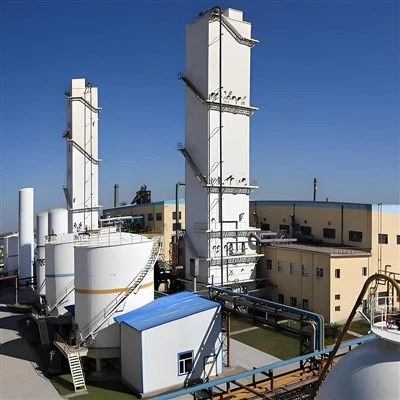
Introduction: Air separation units remain critical equipment in a wide range of applications and industries.
As the demand for industrial gases continues to grow, air separation units (ASUs) provide a reliable and efficient way to produce gases of the required purity. At the same time, the air separation process is a cost-effective way to produce high-purity gases compared to other methods, capable of being produced in large quantities, thereby achieving economies of scale and reducing unit production costs over time. But what exactly is an Air Separation Unit (ASU)? How does it work? What are its main applications? The following is a guide to ASUs based on our experience in cryogenic engineering and the design and manufacture of such structures.
What is an Air Separation Unit?
An Air Separation Unit (ASU) is an industrial facility used to separate atmospheric air into its main components (i.e. nitrogen, oxygen, and sometimes argon and other noble gases). Such units typically consist of elements such as air compressors, air purification systems, heat exchangers, cryogenic cooling systems and distillation columns.
How do air separation units work?
Although air separation units can perform a variety of methods, fractional distillation is the main separation technology used.
The main working principle of an air separation unit (ASU) is to separate air through a process of liquefaction and distillation. The typical operation of an air separation unit is outlined below:
Compression:
In this stage, atmospheric air is drawn into the air separation unit (ASU) and its pressure is increased by a series of compressors. The purpose is to increase the efficiency of the subsequent cooling and separation processes, and the typical pressure range is between 5 and 10 bar gauge.
Purification: Before further processing, the compressed air is usually purified to remove impurities (including moisture, carbon dioxide or trace contaminants). This step ensures that the separated gas is of high purity and avoids problems such as freezing or clogging of cryogenic equipment.
Cooling:
The purified compressed air is cooled to low temperatures through a series of heat exchangers and refrigeration cycles. Since cryogenic distillation relies on the difference in boiling points of different components, the air is liquefied.
Separation:
The now cold, liquefied air is fed into a distillation column (or series of distillation columns) in order to separate the air into its main components based on differences in boiling points:
Nitrogen has a lower boiling point (-196°C or -321°F) than oxygen (-183°C or -297°F).
If separated, argon has an even lower boiling point (-186°C or -303°F).
As the air rises in the column, the temperature gradually increases and the different components evaporate at their respective boiling points. For example, oxygen-rich vapor rises to the top of the column, while nitrogen-rich liquid collects at the bottom. If argon is present, it is usually extracted as a by-product at an intermediate point in the column.
Collection, Storage and Delivery:
The separated gases are collected and sent to storage tanks (pressure tanks or cryogenic tanks). The gases can then be distributed and supplied to various industries and applications, depending on the purity requirements.
In these operations, the operation of the air separation unit is crucial, presenting a close integration of heat exchangers and separation columns to ensure their efficiency.
Applications of ASU
Healthcare:
The use of oxygen and other technical gases in the healthcare industry can benefit from ASU
Industrial processes:
Air separation units are part of cryogenic technology used in industry for processes such as metal manufacturing, chemical production and wastewater treatment. It is also used to produce high purity gases for processes such as wafer fabrication and device manufacturing in the semiconductor industry.
Food and beverages:
Nitrogen is part of the so-called "food gases" and is used in the food and beverage industry to package and preserve products.
Energy production:
Air separation units (ASUs) can provide high purity oxygen for combustion processes in power plants and steel mills.
With more than three decades of knowledge and experience in cryogenic engineering, NEWTEK has become one of the leading suppliers of advanced air separation units. Our strength lies in our ability to adapt to the specific needs of each project, taking into account its entire life cycle, potential and limitations.
Combining innovative technologies with end-to-end engineering services, we have designed, manufactured and implemented a series of successful ASU projects while complying with relevant standards.
Therefore, NEWTEK's work covers key processes from material procurement to assembly of equipment, electrical and piping, as well as factory acceptance testing (FAT) of containerized ASU components. Our focus on planning, drawing, calculation and 3D modeling is our strength, allowing us to provide tailor-made end-to-end services.
Finally, we have excellent production capabilities and are committed to realizing our customers' projects while ensuring the highest quality standards.
Our success stories include:
Supplying components for containerized ASU projects. A containerized ASU is a prefabricated or modular ASU that is easy to transport, assemble, commission and install. Finally, we created a containerized ASU that uses advanced rapid cooling and refrigeration technology to ensure its cost-effectiveness.
Looking for a reliable, advanced and personalized ASU project? Look no further. At NEWTEK, we are committed to meeting the needs of each project while ensuring the highest manufacturing quality and cost-effectiveness. Welcome to contact us to discuss how our team can help you.