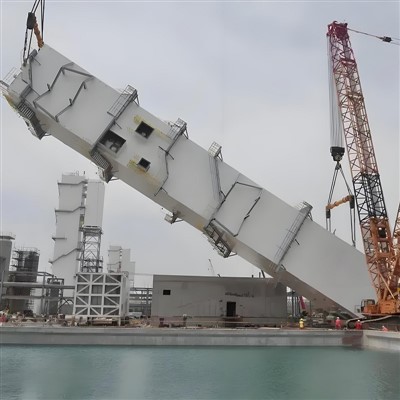
Oxygen Gas Manufacturing Plant Description
I. Air Compression
Ambient air first passes through an air filter to remove dust before entering the air compressor:
Compressed to approximately 0.6–1.0 MPa
Increasing air density creates conditions for subsequent cooling and separation. The compression process generates heat, which needs to be cooled by an intercooler and aftercooler.
II. Air Pretreatment
Compressed air enters the pretreatment system (APS), whose main function is to remove impurities:
Moisture (H₂O)
Carbon dioxide (CO₂)
Hydrocarbons
Molecular sieve adsorbers are typically used for periodic adsorption and regeneration to prevent impurities from freezing at low temperatures and clogging pipelines or distillation columns.
III. Cryogenic Cooling
The purified air enters the main heat exchanger:
Countercurrent heat exchange occurs with the low-temperature product gas returning from the distillation column
The air temperature gradually decreases to -170℃ ~ -180℃
Part of the air is liquefied
This is a crucial step in achieving low-energy operation of the air separation unit.
IV. Rectification Process
Cooled air enters the distillation column system, typically including:
Lower column (high-pressure column)
Upper column (low-pressure column)
- (Some units include an argon column)
Separation Principle:
Different gases have different boiling points:
Nitrogen: -196℃
Oxygen: -183℃
Argon: -186℃
Through multi-stage gas-liquid contact and repeated evaporation and condensation within the column:
Nitrogen is enriched at the top of the column
Oxygen is enriched at the bottom of the column
Argon is extracted in the middle for further purification.
V. Product Recovery
The separated products are processed according to requirements:
Gaseous oxygen/nitrogen: Directly supplied after reheating
Liquid oxygen/nitrogen/argon: Stored in cryogenic tanks
A liquid filling system or centralized pipeline gas supply system can be configured.
Oxygen purity can reach 99.5%–99.9%, and nitrogen purity can reach 99.999%.
Oxygen gas plants serve diverse industries, including:
Hospitals & healthcare facilities (medical oxygen supply)
Steel and metal industries (combustion enhancement, refining)
Chemical & pharmaceutical sectors (oxidation and synthesis processes)

How is an Air Separation Unit customized according to required gas purity and product mix?
ASU customization starts with defining the required product composition and purity levels, such as oxygen (99.5–99.9%), nitrogen (up to 99.999%), and argon recovery. Based on these targets, the distillation column configuration (single column, double column, or triple column with argon system) is designed accordingly. Tray or structured packing type, reflux ratio, and operating pressure are optimized to ensure stable purity while minimizing energy consumption.
How do you determine the capacity and scalability of a customized ASU project?
ASU capacity is designed based on peak and continuous gas demand, future expansion plans, and operating mode (gas supply, liquid backup, or combined supply). For industrial projects, capacity margins are typically reserved to avoid bottlenecks during load fluctuations. Modular design allows future expansion by adding cold boxes, compressors, or storage systems without major disruption to existing operations.
How is the ASU optimized for energy efficiency in different operating conditions?
Energy optimization is achieved by customizing compressor stages, turbine expanders, and main heat exchanger design. For large-capacity projects, optimized pressure ratios and high-efficiency expansion turbines significantly reduce specific power consumption. Heat integration between feed air and product streams is carefully engineered to maximize cold energy recovery and lower long-term operating costs.
Hot Tags: oxygen gas manufacturing plant, China oxygen gas manufacturing plant manufacturers, suppliers