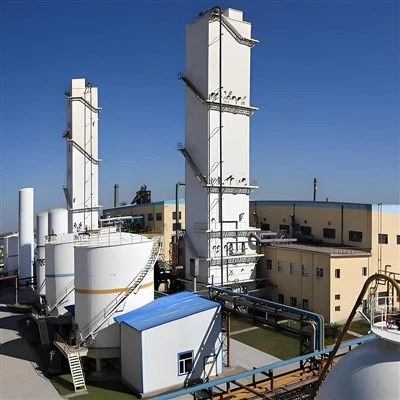
Features & Advantages
One of the main advantages of an industrial gas air separation unit is its ability to deliver large volumes of high-purity gases with exceptional operational stability. Compared with alternative gas generation technologies, cryogenic ASUs are particularly suitable for medium to large capacity projects, offering superior purity levels, long-term reliability, and lower unit gas costs under continuous operation. High-efficiency compressors, advanced heat exchangers, and optimized distillation columns work together to reduce energy consumption while maintaining stable output and product quality..
They are widely applied across diverse industries. In the steel and metallurgy sector, oxygen produced by ASUs enhances combustion efficiency and supports refining processes, while nitrogen is used for inerting and protection. In chemical and petrochemical plants, nitrogen and oxygen are essential for reaction control, purging, and explosion prevention. Medical and healthcare systems rely on ASUs for centralized oxygen supply, especially in large hospitals. Additionally, electronics, food processing, energy, and glass manufacturing industries use high-purity nitrogen and oxygen to improve product quality and process consistency.

What types of gases can an Gas Air Separation Unit produce, and at what purity levels?
An gas air separation unit is capable of producing oxygen, nitrogen, and argon simultaneously or individually, depending on the system configuration. Using cryogenic distillation technology, the unit can achieve high and stable purity levels, typically up to 99.5–99.9% for oxygen and 99.999% for nitrogen, with argon recovery available as an optional configuration. Purity, pressure, and output form (gaseous or liquid) can be customized to match specific industrial process requirements.
Why is a cryogenic air separation unit preferred for large-scale industrial gas production?
Cryogenic air separation units are particularly suitable for medium to large-scale gas demand because they offer continuous operation, high product purity, and lower unit gas cost over long-term use. Compared with PSA or membrane systems, cryogenic ASUs are more energy-efficient at higher capacities and provide superior reliability for 24/7 industrial operation. Their modular design also allows integration with existing plant infrastructure and future capacity expansion.
What are the key safety and maintenance considerations for operating an industrial ASU?
Safe operation of an industrial gas air separation unit requires strict control of air intake quality, operating temperatures, and pressure levels. Regular maintenance of compressors, purification systems, and cryogenic components is essential to prevent blockages and efficiency loss. Proper ventilation, oxygen deficiency monitoring, and adherence to standard operating procedures help mitigate risks associated with oxygen enrichment or nitrogen release. With routine inspections and automated control systems, the ASU can operate safely and reliably over its full lifecycle.
Hot Tags: industrial gas air separation unit, China industrial gas air separation unit manufacturers, suppliers