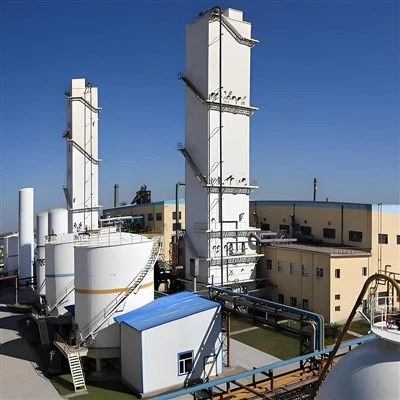
High-Purity Gas Output
Provides up to 99.6% gas purity, ensuring oxygen, nitrogen, argon, and other gases meet the high standards of various industries.
Energy-Efficient and High-Performance
Adopts advanced separation technology and optimized design to reduce energy consumption, offering efficient gas separation and lowering operational costs.
Intelligent Control and Reliability
Features an automatic control system for stable operation, with real-time optimization to minimize downtime and reduce maintenance requirements.

Process description:
Device configuration: Molecular sieve is used to purify air, liquid process with booster expander and air circulation booster, the lower tower is a sieve plate tower, the upper tower is a structured packing tower, and argon is not produced.
Air treatment and distillation: After filtering, compression and pre-cooling, the raw air is removed by molecular sieve, part of it is used as instrument air, and the rest is cooled and enters the lower tower for distillation to obtain liquid air and pure liquid nitrogen. After supercooling and throttling, it enters the upper tower for further distillation to obtain pure liquid oxygen, pure nitrogen, etc.
Product and gas use: Liquid oxygen and pure liquid nitrogen are stored or exported as products; pure nitrogen and dirty nitrogen are reheated and then discharged from the cold box, and dirty nitrogen is used for molecular sieve regeneration.
Process parameters
| Product Name | Yield | purity (V/V) | Outlet pressure | Remark |
| Nm³/h | MPa(G) | |||
| Liquid Oxygen | 1500 | ≥99.6% O₂ | Into the tank | continuous |
| Liquid Nitrogen | 300 | ≤3ppm O₂ | Into the tank | continuous |
| Liquid Argon | 40 | ≤1.5ppm O₂,≤4ppm N₂ | Into the tank | continuous |
FAQ
What types of gas separation technologies are used in Industrial Gas Separation Units?
Main technologies include cryogenic distillation, Pressure Swing Adsorption (PSA), and membrane separation, chosen based on gas purity and volume requirements.
How long does it take to start up an ASU?
Large-scale cryogenic ASUs typically require 12–24 hours to reach full operational stability, depending on system design and capacity.
What maintenance does an ASU require?
Routine maintenance includes filter changes, leak checks, turbine inspection, and periodic cleaning of heat exchangers and adsorption beds.
Hot Tags: industrial gas separation unit, China industrial gas separation unit manufacturers, suppliers, cryogenic asu for aerospace industry, cryogenic asu for construction gas production, cryogenic asu for environmental protection, cryogenic asu for oil and gas industry, cryogenic asu for pharmaceutical industry, cryogenic asu for research and development