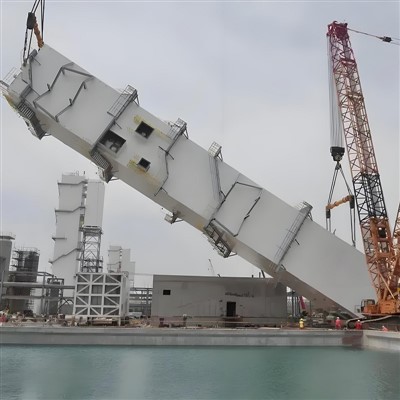
An LNG processing plant is a plant that purifies and cools natural gas to around -162°C to liquefy it, removes impurities and moisture, and produces liquefied natural gas (LNG). The product has the characteristics of high calorific value, low pollution, and easy storage and transportation, providing the energy sector with clean and efficient liquid natural gas fuel and related derivatives.
Detailed flow chart of the whole process of natural gas liquefaction

Pretreatment stage
Preliminary purification
Remove mechanical impurities such as dust, water, condensate, etc. from natural gas
Use filter separators, gravity separators and other equipment to achieve preliminary separation
Removal of corrosive impurities
Removal of hydrogen sulfide (H₂S): through amine washing process (such as MEA, DEA solution) or dry desulfurization agent adsorption.
Removal of mercury (Hg): Use zinc sulfide adsorbent or activated carbon adsorption to prevent corrosion and freezing of heat exchangers.
Acid gas removal and dehydration
Acid gas removal
Removal of carbon dioxide (CO₂): Chemical absorption through amine absorber (such as methyldiethanolamine MDEA)
Control the CO₂ content ≤50ppm to avoid dry ice blocking the pipeline during liquefaction
Dehydration treatment
Use solid adsorbent (molecular sieve, silica gel) or triethylene glycol (TEG) absorption method to remove moisture
Control the water content ≤1ppm to prevent ice damage to equipment during liquefaction
Heavy hydrocarbon separation
Fractionation process
Natural gas is fractionated through a distillation tower to separate pentane and heavier hydrocarbons (C5+)
Heavy hydrocarbons can be recovered as by-products to avoid the formation of hydrocarbon crystals during liquefaction
Liquefaction stage
Precooling treatment
Use propane or ammonia refrigeration cycle to preliminarily cool natural gas
Deep refrigeration liquefaction
Use mixed refrigerant (N₂, C₁-C₅ hydrocarbon mixture) refrigeration cycle
Cool to the liquefaction point (-162℃, -260℉), the volume of natural gas is reduced to 1/600 of the original volume
Liquefied natural gas (LNG) storage
Store LNG in double-walled insulated storage tanks (vacuum powder insulation or foam glass insulation) to maintain a temperature of ≤-160℃
Storage and transportation
Onshore storage
Use large insulated storage tanks (capacity can reach 100,000-200,000 cubic meters) for short-term storage
Marine transportation
Use dedicated LNG Transport by transport ship (equipped with low-temperature resistant invar steel tank or C-type independent storage tank)
The transport temperature is maintained at -162℃ and the pressure is close to normal pressure
Regasification stage
LNG gasification
At the receiving terminal, LNG is heated to gaseous state through seawater heat exchanger and air-temperature vaporizer (ORV)
The gasified natural gas temperature is ≥5℃, which meets the pipeline transportation requirements
Pipeline network transportation
Transported to urban gas network or industrial users through high-pressure gas pipeline
Hot Tags: lng process plant, China lng process plant manufacturers, suppliers