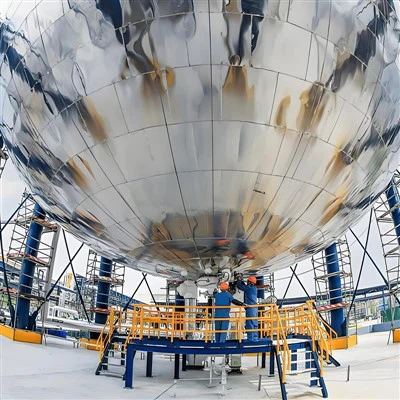
Industrial-grade oxygen is a crucial resource across various sectors, from steelmaking and chemical production to wastewater treatment and medical applications. As a leading supplier of oxygen plants, I'm excited to take you through the intricate process of how an oxygen plant produces industrial-grade oxygen.
Understanding the Source: Air
The primary source of oxygen for industrial production is the air we breathe. Air is a mixture of approximately 78% nitrogen, 21% oxygen, and 1% other gases such as argon, carbon dioxide, and trace amounts of neon, helium, and methane. The process of extracting oxygen from air involves several key steps, each designed to separate and purify the oxygen to meet industrial standards.
Air Compression
The first step in the oxygen production process is air compression. Ambient air is drawn into the oxygen plant through an intake system and then compressed to a high pressure, typically between 5 and 10 bar. This compression increases the density of the air, making it easier to separate the individual components. Compression is usually achieved using large compressors, which can be powered by electricity or steam.
Air Pre - treatment
Once the air is compressed, it undergoes pre - treatment to remove impurities such as dust, water vapor, and carbon dioxide. These impurities can cause problems in the subsequent separation process and may also contaminate the final oxygen product.
Dust is removed using filters, which can be made of various materials such as fiberglass or activated carbon. Water vapor is removed through a process called adsorption, where the compressed air is passed through a bed of desiccant material, such as silica gel or molecular sieves. These materials have a high affinity for water and can effectively remove moisture from the air.
Carbon dioxide is also removed through adsorption, typically using a molecular sieve. Molecular sieves are porous materials with a specific pore size that allows them to selectively adsorb certain molecules based on their size and shape. In the case of carbon dioxide removal, the molecular sieve is designed to adsorb carbon dioxide while allowing other gases to pass through.
Cryogenic Distillation
The heart of the oxygen production process is cryogenic distillation, which is based on the principle that different gases have different boiling points. At very low temperatures, air can be liquefied, and the individual components can be separated by distillation.
The pre - treated compressed air is cooled to extremely low temperatures, typically below - 170°C, using a series of heat exchangers and refrigeration systems. As the air cools, it liquefies, and the liquid air is then fed into a distillation column.
In the distillation column, the liquid air is separated into its individual components based on their boiling points. Nitrogen has a lower boiling point (- 196°C) than oxygen (- 183°C), so it vaporizes first and rises to the top of the column, while oxygen remains in the liquid phase and collects at the bottom. The separation process is enhanced by the use of trays or packing materials inside the column, which provide a large surface area for the exchange of heat and mass between the vapor and liquid phases.
Purification
The oxygen obtained from the cryogenic distillation process is typically around 99.5% pure. However, for some industrial applications, higher purity levels may be required. To achieve this, the oxygen may undergo further purification steps.
One common purification method is catalytic oxidation, where trace amounts of impurities such as carbon monoxide and hydrocarbons are oxidized to carbon dioxide and water using a catalyst. The carbon dioxide and water can then be removed through adsorption or other separation techniques.


Another purification method is pressure - swing adsorption (PSA), which can be used to remove residual nitrogen and other impurities from the oxygen. PSA works on the principle that certain adsorbent materials have a higher affinity for nitrogen than oxygen at high pressures. By cycling the pressure in a bed of adsorbent material, nitrogen can be selectively adsorbed and removed from the oxygen stream.
Storage and Distribution
Once the oxygen has been produced and purified, it is stored in large storage tanks or cylinders. Oxygen can be stored in either the gaseous or liquid state, depending on the application and the volume of oxygen required.
Gaseous oxygen is typically stored in high - pressure cylinders or in large storage vessels at pressures up to 200 bar. Liquid oxygen is stored in insulated cryogenic tanks at very low temperatures and can be stored in much larger volumes than gaseous oxygen.
For distribution, oxygen can be transported by trucks, railcars, or pipelines. Trucks are commonly used for small - to medium - scale oxygen deliveries, while pipelines are used for large - scale distribution over long distances.
The Role of Advanced Equipment
In modern oxygen plants, advanced equipment plays a crucial role in ensuring efficient and reliable oxygen production. For example, LNG Process Plant technology can be integrated into the oxygen production process to optimize energy consumption and improve overall plant performance. LNG Process Plants can provide a source of cold energy, which can be used in the cryogenic distillation process, reducing the need for external refrigeration.
Another important piece of equipment is the Cryogenic Gas Separator. Cryogenic Gas Separators are designed to efficiently separate different gases at low temperatures, ensuring high - purity oxygen production. These separators use advanced materials and design techniques to minimize heat transfer and improve separation efficiency.
Contact for Procurement
If you're in the market for an oxygen plant or need industrial - grade oxygen for your business, I invite you to reach out to us. We have a team of experts who can provide you with customized solutions based on your specific requirements. Whether you need a small - scale oxygen plant for a local business or a large - scale industrial oxygen production facility, we have the experience and expertise to meet your needs. Contact us today to start the procurement process and discuss how we can help you achieve your oxygen production goals.
References
- Kohl, A. L., & Nielsen, R. B. (1997). Gas Purification. Gulf Publishing Company.
- Perry, R. H., & Green, D. W. (1997). Perry's Chemical Engineers' Handbook. McGraw - Hill.
- Walas, S. M. (1985). Chemical Process Equipment: Selection and Design. Butterworth - Heinemann.