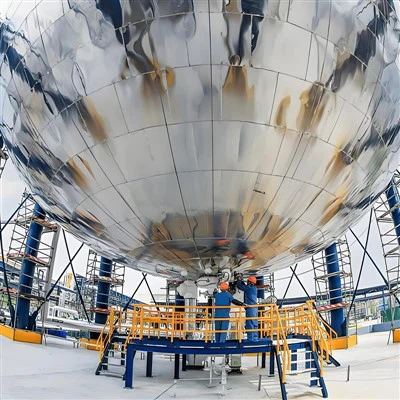
What are the future prospects of Carbon Capture Plants?
In an era where climate change looms large as one of the most pressing global challenges, carbon capture plants have emerged as a technology with incredible potential. As a supplier of Carbon Capture Plant, I am deeply invested in exploring and understanding the future prospects of these facilities.
Current State of Carbon Capture Technology
Carbon capture technology is not a new concept. It involves capturing carbon dioxide (CO2) emissions at their source, such as power plants or industrial facilities, before they are released into the atmosphere. The captured CO2 can then be transported and stored underground in geological formations or used in various industrial processes.
Today, there are several commercial carbon capture projects around the world. These projects have demonstrated the technical feasibility of capturing CO2 emissions. However, the widespread adoption of carbon capture plants has been hampered by high costs. Building and operating a carbon capture plant requires significant investment in infrastructure, energy, and materials. Additionally, the lack of a well - established market for the captured CO2 has also limited the growth of the industry.
Environmental and Regulatory Drivers
One of the main factors driving the future prospects of carbon capture plants is the growing global concern about climate change. The Paris Agreement, which aims to limit global warming to well below 2 degrees Celsius above pre - industrial levels, has spurred countries to set ambitious climate targets. Many industrialized nations are now committed to reducing their greenhouse gas emissions, and carbon capture is seen as a crucial tool to achieve these goals.
In addition to international agreements, national and regional regulations are also playing a significant role. For example, some countries have implemented carbon taxes or emission trading schemes, which create economic incentives for industries to reduce their CO2 emissions. These policies encourage the adoption of carbon capture technologies as a means of compliance.
Technological Advancements
The future of carbon capture plants looks promising due to ongoing technological advancements. New and improved capture technologies are being developed that are more efficient and cost - effective. For instance, some research is focused on developing advanced solvents that can capture CO2 more selectively and with less energy consumption.
Another area of innovation is the integration of carbon capture with other technologies. For example, the combination of Co2 Air Separation Unit with carbon capture plants can enhance the overall efficiency of the process. By separating CO2 from the air more effectively, it becomes easier to capture and utilize the gas.
Moreover, the development of direct air capture (DAC) technology is a game - changer. DAC systems can capture CO2 directly from the ambient air, which means that carbon capture is not limited to industrial sources. This technology has the potential to remove historical CO2 emissions from the atmosphere, making it a powerful tool in the fight against climate change. Although DAC is currently more expensive than traditional carbon capture methods, continuous research and development are expected to bring down the costs in the future.
Economic Opportunities
There are significant economic opportunities associated with carbon capture plants. The captured CO2 can be used in various industries, creating new markets and revenue streams. For example, CO2 can be used in enhanced oil recovery (EOR) operations. In EOR, CO2 is injected into oil reservoirs to increase the amount of oil that can be extracted. This not only provides an economic benefit for the oil industry but also helps to store the CO2 underground.
Another emerging market is the use of CO2 in the production of chemicals and fuels. With the development of new catalysts and processes, it is becoming possible to convert CO2 into valuable products such as methanol, polymers, and synthetic fuels. This represents a shift from treating CO2 as a waste product to a valuable feedstock.
Role of Carbon Capture in the Energy Transition
As the world transitions from fossil fuels to renewable energy sources, carbon capture plants can play a crucial bridging role. While renewable energy technologies such as solar and wind power are growing rapidly, they still face challenges such as intermittency. Fossil fuels will continue to be part of the energy mix for the foreseeable future, especially in regions where renewable energy infrastructure is not fully developed.
Carbon capture plants can help to reduce the carbon footprint of fossil fuel - based power plants and industrial facilities during this transition period. They allow these industries to continue operating while significantly reducing their environmental impact. Additionally, carbon capture can be integrated with biomass power plants to achieve negative emissions, which means removing more CO2 from the atmosphere than is emitted.
Challenges Ahead
Despite the bright prospects, there are still several challenges that need to be overcome for the widespread adoption of carbon capture plants. One of the most significant challenges is the high capital and operating costs. To make carbon capture more economically viable, significant government subsidies and incentives may be required in the short - to medium - term.
Another challenge is public perception. Some people are concerned about the safety of storing large amounts of CO2 underground, especially in terms of potential leakage. Addressing these concerns through transparent communication and rigorous safety standards is essential for the acceptance of carbon capture projects.


The development of a regulatory framework for carbon capture, utilization, and storage (CCUS) is also a work in progress. Clear and consistent regulations are needed to govern the capture, transportation, and storage of CO2, as well as the use of CO2 in various industries.
Our Role as a Carbon Capture Plant Supplier
As a supplier of Carbon Capture Plant and related technologies, we are at the forefront of the industry. We are constantly investing in research and development to improve the efficiency and reduce the cost of our products. Our goal is to provide our customers with state - of - the - art solutions that meet their carbon capture needs.
We understand the challenges that our customers face, including regulatory compliance and cost constraints. That's why we offer customized solutions that are tailored to the specific requirements of each project. Whether it's a large - scale industrial facility or a small - scale power plant, we have the expertise to design and install a carbon capture plant that is efficient and reliable.
Future Outlook
Looking ahead, the future of carbon capture plants is very promising. With the increasing global focus on climate change, the demand for carbon capture technologies is expected to grow significantly. Technological advancements will continue to drive down costs and improve the efficiency of carbon capture plants.
The development of new markets for the captured CO2, such as in the production of chemicals and fuels, will also provide additional economic incentives for the adoption of carbon capture. Moreover, as more countries implement policies to reduce their greenhouse gas emissions, the regulatory environment for carbon capture is likely to become more favorable.
We believe that carbon capture plants have a crucial role to play in achieving global climate targets. They offer a practical and effective solution to reducing CO2 emissions from existing industrial sources and can contribute to the overall decarbonization of the economy.
Contact Us for Procurement
If you are interested in exploring the potential of Carbon Capture Plant for your business, we invite you to contact us. Our team of experts is ready to discuss your specific needs and provide you with a detailed proposal. Whether you are looking for a new carbon capture plant, an upgrade to an existing facility, or a Co2 Air Separation Unit to enhance your operations, we have the solutions you need. Let's work together to create a more sustainable future.
References
- IPCC Special Report on Global Warming of 1.5°C.
- International Energy Agency (IEA) reports on carbon capture, utilization, and storage.
- Academic research papers on carbon capture technologies and their economic and environmental impacts.