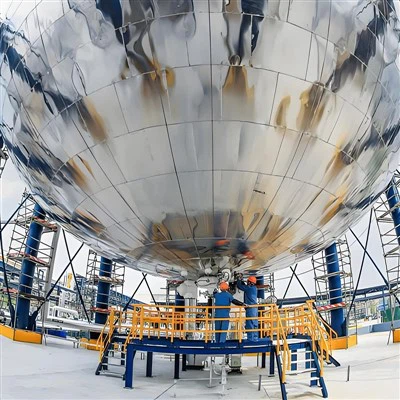
Hey there! I'm a supplier for Carbon Removal Plants, and today I wanna chat about the cool technologies used in these plants. Carbon removal is super important in the fight against climate change, and these plants are at the forefront of making it happen.
Direct Air Capture (DAC)
One of the most well - known technologies in carbon removal plants is Direct Air Capture. DAC systems work by pulling in air from the surrounding environment. It's like a big, high - tech vacuum cleaner for carbon dioxide. Inside the plant, the air passes through a series of filters and chemical sorbents. These sorbents are like little sponges that soak up the CO2 from the air.
There are different types of sorbents. Some are solid, like special kinds of resins or metal - organic frameworks. These solid sorbents can be very efficient at capturing CO2, and they can be regenerated, which means they can be reused after the CO2 is removed. For example, once the solid sorbent is full of CO2, it can be heated up. This causes the CO2 to be released, and the sorbent is ready to capture more CO2 again.
Other sorbents are liquid, such as amine - based solutions. These liquids react with the CO2 in the air, forming a compound. Then, through a process called stripping, the CO2 is separated from the liquid. DAC is really exciting because it can capture CO2 directly from the atmosphere, no matter where the plant is located. You can check out more about the general concept of carbon - related plants at Carbon Removal Plant.
Mineralization
Mineralization is another key technology. It's all about turning CO2 into solid minerals. This process mimics what happens in nature over long periods of time, but in a much faster way. In a carbon removal plant, CO2 can be injected into certain types of rocks, like basalt. Basalt is rich in minerals such as calcium, magnesium, and iron. When CO2 reacts with these minerals, it forms stable carbonate minerals.
The process usually involves crushing the rocks to increase their surface area, so that the CO2 can react more easily. Then, the CO2 is dissolved in water to form a carbonic acid solution. This solution is then pumped into the rock formations. Over time, the chemical reactions take place, and the CO2 is locked away in the form of solid minerals. This is a really long - term and secure way of storing carbon. It's like putting the CO2 in a geological safe.
Bioenergy with Carbon Capture and Storage (BECCS)
BECCS is a combination of different technologies. First, biomass, such as wood chips, agricultural waste, or dedicated energy crops, is burned or fermented to produce energy. This energy can be used for electricity generation or other industrial processes. But here's the cool part: while the biomass is being used for energy, the CO2 that is produced during this process is captured.
The capture part can use similar technologies as in DAC, like sorbents. Once the CO2 is captured, it is then stored underground in geological formations. Since the biomass absorbs CO2 from the atmosphere while it is growing, BECCS can actually result in negative emissions. That means it removes more CO2 from the atmosphere than it emits. You can learn more about related carbon - based facilities at Carbon Dioxide Factory.
Electrochemical Technologies
Electrochemical technologies are also emerging in carbon removal plants. These use electricity to drive chemical reactions that capture and convert CO2. For example, some electrochemical cells can split CO2 into carbon monoxide (CO) and oxygen (O2). The CO can then be used as a feedstock for the production of fuels or chemicals.
Another approach is to use electrochemical reduction to convert CO2 into useful products, like formic acid or methanol. These products can be used in various industries, from the chemical industry to the energy sector. Electrochemical technologies are still in the early stages of development, but they have a lot of potential because they can be very efficient and can produce valuable products at the same time.
Ocean - Based Carbon Removal
The ocean is a huge carbon sink, and carbon removal plants are starting to take advantage of this. One method is ocean alkalinity enhancement. By adding alkaline substances, like crushed limestone, to the ocean, the ocean's ability to absorb CO2 can be increased. The alkaline substances react with the CO2 in the water, forming bicarbonate ions. This not only helps to remove CO2 from the atmosphere but also helps to counteract ocean acidification.
Another ocean - based approach is artificial upwelling. This involves bringing nutrient - rich deep - ocean water to the surface. The nutrients can stimulate the growth of phytoplankton. Phytoplankton absorb CO2 during photosynthesis. When the phytoplankton die, they sink to the ocean floor, taking the carbon with them.
Integration of Technologies
In a real - world carbon removal plant, these technologies are often integrated. For example, a plant might use DAC to capture CO2 from the air, and then use mineralization to store the captured CO2. Or, it could combine BECCS with electrochemical technologies to produce energy and valuable chemicals at the same time. This integration allows for a more efficient and effective carbon removal process.
Why These Technologies Matter
All these technologies are crucial in the global effort to reduce greenhouse gas emissions. Carbon removal plants can help to offset emissions that are difficult to eliminate completely, such as those from some industrial processes or aviation. They also play a role in achieving the goals of the Paris Agreement, which aims to limit global warming to well below 2 degrees Celsius above pre - industrial levels.
If you're interested in carbon removal and are thinking about setting up a carbon removal plant or upgrading an existing one, I'm here to help. As a supplier, I have access to the latest technologies and can provide you with the equipment and expertise you need. Whether it's the sorbents for DAC, the machinery for mineralization, or the electrochemical cells, I've got you covered.


If you want to learn more about carbon - related plants, you can also check out Co2 Generation Plant. Don't hesitate to reach out for a chat about your specific needs and how we can work together to make a positive impact on the environment. Let's start this journey of carbon removal and make our planet a better place!
References
- IPCC Special Report on Global Warming of 1.5°C
- International Energy Agency (IEA) reports on carbon capture and storage
- Scientific research papers on direct air capture, mineralization, BECCS, electrochemical technologies, and ocean - based carbon removal.