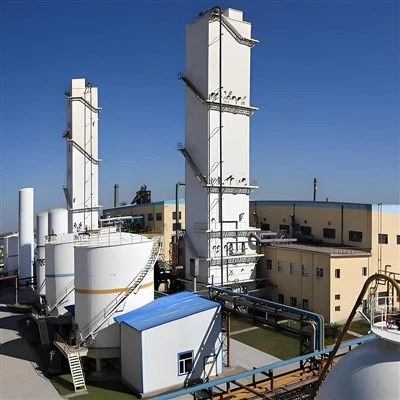
Introduction: Industries such as heavy chemical, metallurgy, glass, chemical, and electronics have a high demand for high-purity oxygen (O₂), nitrogen (N₂), and argon (Ar). To ensure the continuity, purity, and economy of gas supply, an increasing number of large plants are choosing to install cryogenic air separation units (ASUs) on-site instead of relying on purchased gases. Choosing the right ASU is crucial for ensuring stable production, saving operating costs, and optimizing return on investment.
This article will discuss in detail how to select an ASU for a specific project from three key dimensions-Capacity, Energy Consumption & OPEX, and CAPEX & Total Investment-and, in conjunction with NEWTEK's EPC & Turnkey service model, illustrate how to achieve an efficient and reliable solution through one-stop delivery, encompassing engineering design, equipment procurement, construction and installation, commissioning, and operational delivery.

1. ASU Basic Principles and Applicable Scenarios
First, let's briefly review the basic working principle of a cryogenic ASU. A cryogenic ASU works by compressing, purifying (removing moisture, CO₂, and impurities) air, cooling it to extremely low temperatures (approximately -180°C to -200°C), and then separating the components based on their boiling point differences in a fractionation column. Nitrogen (N₂), oxygen (O₂), and argon (Ar) can be output as product gases (or liquids), respectively. Depending on the scale and configuration of the unit (single-column, double-column, or triple-column with argon recovery), ASUs are widely applicable in steelmaking (blast furnace oxygen enrichment, converter blowing), petrochemical/gasification (requiring large amounts of oxygen for partial oxidation reactions), glass melting furnaces (oxy-fuel), chemical synthesis, electronics/semiconductors (ultra-high purity nitrogen/argon), large-scale heat treatment, and inert atmosphere furnaces. Therefore, ASUs are often core infrastructure in large and medium-sized industrial projects, and their design must be highly customized based on downstream needs (gas production volume, purity, pressure) and local conditions.
2. Capacity: Determining ASU Size Based on Demand.
The primary consideration when selecting an ASU is its capacity (i.e., how many tons/standard cubic meters of O₂/N₂/Ar it can produce per day). This capacity must match the peak gas consumption and expected growth of downstream processes.
The capacity range of cryogenic ASUs is very wide. According to industry data, small single-column units may produce tens to hundreds of tons of oxygen per day; double-column/medium-sized systems can reach hundreds to two thousand tons per day; while large multi-column units (including argon recovery) can achieve thousands to several thousand tons of O₂ production per day. Specifically, data shows that the capacity range of a typical large industrial ASU can cover approximately 100 to over 5,000 tons/day of O₂. When selecting capacity, peak load (blast furnaces, converters, gasifiers, and furnaces may require large amounts of oxygen during high-load periods), continuous operation requirements (24/7), and future expansion potential should be considered (e.g., adding production lines, increasing capacity, and safety backup/redundancy).
Therefore, for large-scale metallurgical, petrochemical, or glass projects, it is generally recommended to configure medium to large ASUs (hundreds to thousands of tons/day O₂) to ensure stable supply and reduce bottlenecks. For smaller-scale or auxiliary gas applications (e.g., heat treatment nests, localized inert atmospheres, spare capacity), small/modular units can also be considered.
3. Energy Consumption & OPEX: Key Drivers
Once capacity is determined, calculating operating costs (especially electricity consumption) is the next critical step in the selection process, as OPEX often determines long-term economics.
- Energy Consumption Range
The typical specific energy consumption of a cryogenic ASU generally falls within the range of approximately 250–500 kWh/ton O₂ (or approximately 0.3–0.6 kWh/Nm³ O₂).
Some older or smaller designs may have slightly higher (and worse) energy consumption, while modern energy-saving designs employing advanced heat recovery, turbo-expander, and superior heat exchange systems can significantly reduce energy consumption.
Actual energy consumption is also affected by factors such as output pressure, product purity, and gas production structure (whether argon/N₂ is recovered). For example, increasing the delivery pressure/compression ratio or requiring higher purity may increase energy consumption.
- Operating Cost Composition
Depending on the source, electricity costs typically account for ≈70–80% of the operating cost (OPEX). Other costs include personnel (operators, management), maintenance (compressor overhaul, cold box maintenance, tray/packing replacement), catalyst/adsorbent/refrigerant (if applicable) replacement, as well as lubrication, consumables, insurance/taxes, etc. Overall, these miscellaneous items account for approximately 10–20% of OPEX. Therefore, in areas with high electricity costs (or high local industrial electricity prices), ASU operating costs can be an economic burden. Conversely, if the project is located in an area with low electricity prices and cheap/dedicated power (e.g., proximity to power plants, use of waste heat/own power), the operating economics of the ASU will be significantly improved.
Economic Value of By-product Gases (N₂/Ar/Argon)
Many ASUs not only produce oxygen (O₂) but also nitrogen (N₂) and (optionally) argon (Ar). By recovering and selling (or using within the plant) by-product gases, the operating costs/electricity expenses of the ASU can be partially offset. Taking argon as an example, since the argon content in the air is approximately 0.93%, the economic value of recovered argon (or liquid argon) can significantly reduce net O₂ costs if there is a market for it (e.g., in metal casting, electronics, inert protective gases, etc.). Therefore, when selecting and making investment decisions, oxygen production, simultaneous nitrogen/argon production and utilization (internal or market sales) should be comprehensively considered to maximize overall economic efficiency.
4. Investment Costs (CAPEX & Total Project Cost): Scale and Delivery Method Have a Significant Impact
Besides operating costs, capital expenditure (CAPEX) is a crucial factor in ASU selection decisions. The installation and construction costs of ASUs of different sizes/designs/configurations (whether argon recovery is included, multiple trains, multiple columns) vary greatly.
Some industry reports indicate that the purchase cost (PEC) of a small/skid-mounted ASU can be in the millions of dollars; the total installation cost (TPC) after installation and commissioning will be even higher. According to data on a 200 tonnes/day (TPD) ASU, approximately 75% of its lifecycle costs come from energy; therefore, even with low CAPEX, operating OPEX can determine the final economic viability. Based on publicly available industry estimates, for medium-sized (hundreds–thousands of tons/day) ASUs, initial investment (plant, installation, commissioning, infrastructure, piping connections, gas networks, power facilities, insulation boxes, etc.) typically ranges from tens of millions to hundreds of millions of US dollars.
Especially for large-scale, complex systems with argon recovery, multiple trains, and multiple gas outputs (O₂/N₂/Ar), CAPEX is higher, but the unit gas production cost (after amortizing CAPEX + OPEX) is often lower, exhibiting economies of scale.
Therefore, in the early stages of a project (FEED/Investment Assessment phase), the following must be clearly defined:
Design capacity (current + potential future expansion)
Required purity (O₂, N₂, Ar) and output pressure/flow rate
Variation in gas usage (continuous 24/7 or peak + off-season)
Whether argon/nitrogen is needed as a byproduct and whether there are utilization/sales channels
Local electricity prices, power supply stability/cost structure/power contracts (e.g., availability of low-cost industrial electricity)
The complexity of engineering construction (civil engineering, foundations, piping, installation, power/refrigeration/insulation/safety/instrumentation)
Only by comprehensively considering these factors can the total project investment (CAPEX) and future operating economics (unit gas cost) be reasonably estimated.
5. Combining NEWTEK's EPC & Turnkey Model - Providing One-Stop Solutions for Clients
When facing the complex decision-making and engineering challenges mentioned above, selecting a supplier with extensive system integration capabilities and the ability to provide EPC (Engineering, Procurement, Construction) + Turnkey (from design to commissioning and operation) services is crucial to project success. This is precisely NEWTEK's positioning.
Why EPC & Turnkey Matters
Unified Design and Engineering Management: ASU projects involve air compressors, cold boxes, fractionation towers, heat exchangers, piping, insulation, control systems, safety facilities, electrical systems, and infrastructure. Through EPC, general contractors (such as NEWTEK) can coordinate all disciplines (process, structural, electrical, instrumentation, civil, and installation), avoiding multi-supplier interface issues, communication/coordination costs, and potential blind spots in liability.
Procurement and Supply Chain Integration: NEWTEK's resource integration capabilities (gas engineering + global procurement) ensure timely delivery of equipment (compressors, cold boxes, fractionation towers), materials (special steel, insulation materials), and instrumentation control systems, avoiding delivery delays or compatibility risks caused by multiple sourcing channels.
Construction, Installation, and Commissioning: The installation and commissioning of the ASU (cold box insulation, refrigeration system commissioning, airtightness testing, thermal circulation, control system linkage, and safety system inspection) are crucial. The EPC + Turnkey model guarantees installation quality, shortens on-site construction timelines, and enables rapid start-up.
Interface and Downstream Process Integration: For large-scale projects such as metallurgy, chemical engineering, glass manufacturing, and gasification, the ASU is only one part of the overall plant gas supply system. NEWTEK can assist in seamlessly integrating the ASU with downstream processes (combustion furnaces, gasifiers, pipelines, storage tanks, and gas compression systems) to achieve on-demand allocation, storage, and delivery of O₂/N₂/Ar.
Project Delivery and Operational Support: From commissioning, acceptance, and operational training to subsequent maintenance and warranty, the Turnkey model provides users with a "one-stop, worry-free" experience-particularly suitable for new plants without extensive experience in air separation systems.
Therefore, for clients seeking high-efficiency, high-reliability, and high-purity gas supply, and wishing to mitigate project management and technical risks (such as steel mills, petrochemical plants, glass factories, and chemical plants), adopting NEWTEK's EPC + Turnkey model can significantly reduce project complexity, shorten project timelines, and optimize costs.
6. How to Select a Suitable ASU in a Real-World Project - Step-by-Step Recommendations
1. Based on the foregoing analysis, the following is a recommended ASU selection/investment/implementation process, suitable for engineering managers, project investors, or plant decision-makers:
1.1 Determine Gas Demand
1.1.1 Calculate the consumption of O₂/N₂/Ar by each process unit in the project (existing + anticipated expansion) (flow rate, pressure, purity, time distribution)
1.1.2 Estimate peak and average demand, and reserve redundancy/safety margins
1.2 Clarify Gas Quality Requirements
1.2.1 O₂ purity (e.g., 99.5%–99.9%), N₂/Ar purity requirements
1.2.2 Output pressure, gaseous or liquid (e.g., if liquid oxygen/liquid nitrogen storage is required)
1.3 Assess Local Electricity Prices/Energy Conditions
1.3.1 Obtain industrial electricity prices (day/night/peak/negotiated price), power stability, availability of inexpensive/owned/ Waste Heat Power
1.3.2 Calculate the operating cost per unit of gas (O₂/N₂) based on energy costs
1.4 Select ASU Scale and Configuration
1.4.1 Determine single/double/triple train configuration (including argon recovery) based on gas demand; single train is suitable for small-scale/auxiliary gas use, double/triple train is suitable for large and medium-sized/multi-product demand
1.4.2 Consider future expansion and redundancy (e.g., multiple trains in parallel)
1.5 Select Supply/Contracting Model
1.5.1 Prioritize system suppliers capable of providing EPC + Turnkey services (e.g., NEWTEK)
1.5.2 Require suppliers to provide one-stop services from engineering design, equipment procurement, civil engineering/foundation, installation, commissioning, trial operation, operation training to delivery and operation
1.6 Conduct Economic Evaluation (CAPEX + OPEX + Gas By-product Revenue)
1.6.1 Estimate total investment (CAPEX), annual/lifecycle operating costs (mainly electricity + maintenance + (Human Resources)
1.6.2 Estimate the utilization/sales revenue of by-product gas (N₂/Ar) and the net cost compared with purchased gas/auxiliary supply options.
1.7 Risk Assessment and Project Management
1.7.1 Consider equipment delivery time, construction period, commissioning complexity, operational stability, maintenance convenience, safety and regulatory requirements (pressure vessel/refrigeration/safety).
1.7.2 If gas consumption fluctuates or demand increases, consider modular/phased expansion (multi-train) design to reduce one-time investment risk.
7. Summary - Balancing Capacity, Energy Consumption, Investment and Service Capability
Choosing a suitable ASU is a comprehensive trade-off between capacity (meeting demand), energy consumption (operating economics), investment costs (CAPEX and financing costs), project implementation, and operation and maintenance support.
For small or medium-sized users (auxiliary gas, localized use, flexible demand), single-row/modular small ASUs or PSA/membrane systems may be sufficient. However, when demand is stable, the scale is large, and requirements for purity, product diversity, and reliability are high, cryogenic ASUs are the best choice.
Within cryogenic ASUs, appropriate selection (capacity/number of columns/heat recovery) is crucial.
Byproduct gas configuration and energy conservation (excellent compression/cooling/heat exchange design) are key to reducing unit gas costs (O₂/N₂/Ar).
While capital expenditures are not low, with proper design, high equipment utilization (24/7 continuous operation), and full utilization of the value of byproducts (nitrogen, argon), it is easy to control unit gas costs within a competitive range through multi-year operational amortization.
Finally, choosing a supplier with complete EPC + Turnkey service capabilities (such as NEWTEK) can significantly reduce project complexity, construction and commissioning difficulties, cross-disciplinary coordination costs and risks, providing clients with a truly "design-to-operate-integrated, worry-free" solution.
For companies planning to build or expand large-scale chemical/metallurgical/glass/gasification/energy projects, correct selection, reasonable design, and professional EPC + Turnkey contracting are crucial to ensuring the successful, economical, and efficient operation of ASU projects.