

Air separation units have always been a very important auxiliary production unit in petrochemical and coal chemical enterprises. Many large enterprises usually have several sets of air separation units. If calculated based on the oxygen production capacity, it has a device capacity of about 6000-20000m3/h and a capital construction investment of 50-100 million yuan. Through the analysis of these air separation units, we can find that there are many problems in their planning and design, which greatly affects chemical production and benefits. Based on this, this paper analyzes and discusses several problems in the planning and design of air separation units.
Content
1.Process selection issues for air separation units
2.Equipment selection issues for air separation units
2.1 Purification section of air separation units
2.2 Compression section of air separation unit
2.3 Refrigeration and liquefaction section of air separation unit
3.The multifunctionality of air separation units
1. Process selection issues for air separation units
There are two types of purification processes for large air separation units, namely molecular sieve adsorption and switching freezing. Since the oxygen-nitrogen ratio requirements for petrochemical and coal chemical production have certain characteristics, molecular sieve adsorption purification processes are usually selected. For example, in a certain project, the normal oxygen and nitrogen consumption is 1400Omh, but the nitrogen consumption will increase exponentially in the event of an accident. Therefore, once there is a fluctuation in production, it will lead to a problem of nitrogen supply exceeding demand. After the project was put into production, nitrogen was in a tight supply situation for a long time, which greatly restricted the smooth progress of chemical production. In order to effectively solve the problem of tight nitrogen supply, it is necessary to add an air device, such as an air separation device that uses a molecular sieve adsorption purification process, which has a nitrogen output of 13000m/%.
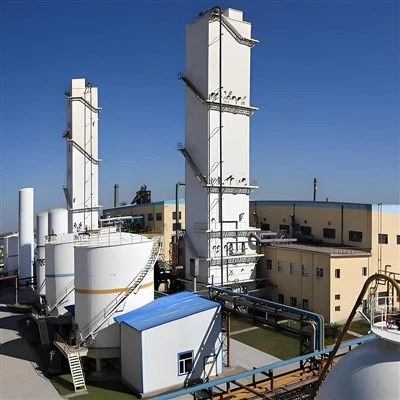

If we analyze it from the perspective of a specific environment for safe production, it is easy to pollute the environment and air in the production of petrochemical and coal chemical enterprises, and the switching freezing method cannot eliminate the low-boiling hydrocarbons, and the hydrocarbons entering the air separation device will pose a great threat to safe production. The above situation will not occur when the molecular sieve adsorption method is used, so it is more applicable in petrochemical production. If we analyze it from the perspective of energy saving, the two methods have roughly the same amount of raw air, but the molecular sieve adsorption method will have a nitrogen output that is twice as high.
2 Equipment selection issues for air separation units
2.1 Purification section of air separation unit
There are two types of molecular sieve adsorption purifiers, namely horizontal and vertical. Among them, the horizontal purifier has a large resistance and is prone to uneven flow rate. The vertical molecular sieve purifier is filled with UCC13X molecular sieve as a fixed bed, and the air in it can flow vertically, which has a very good purification effect.
2.2 Compression section of air separation unit
The high-speed turbine can directly drag the high-speed compressor, thereby completing the speed matching work, and effectively preventing the situation of gear transmission, and further preventing noise pollution. Therefore, based on the analysis from the perspective of environmental protection and reliability, we believe that compared with the motor drag method, the use of steam turbine as the prime mover has a better effect, and it is very beneficial for the localization of large-scale air separation.
2.3 Refrigeration and liquefaction section of air separation unit
In the air separation tower, the pressure of the lower tower is significantly higher than the pressure of the upper tower, and the air entering the upper tower from the lower tower itself has an expansion process.
3. The multifunctionality of air separation units
In the production of the petrochemical industry, pneumatic instruments are used in large quantities, which leads to a very large consumption of miscellaneous compressed air and instrument compressed air in chemical production. Usually, a public air compressor station is set up to compress the air, and after dehydration and drying, air is uniformly provided to auxiliary devices and chemical devices. By analyzing the processing media, equipment and production processes of the air compressor station and the air separation unit, we can find that they have the same main consumable materials, but they do not use liquefaction and diversion to process miscellaneous air and instrument compressed air. Based on this, the air compressor station and the air separation unit can be combined and constructed, thereby saving the fixed number, floor space and investment. Simply put, the combined construction plan is to install the air compressor station equipment within the boundary area of the air separation unit; you can also choose the compressor of the air separation unit to uniformly provide compressed air, and then send it to the instrument air system and the air separation system respectively. Because the compressed air for instrumentation and the compressed air for air separation systems have different pressures, the outlet pressure of the raw air compressor should be increased to ensure that the total inlet air is the sum of the miscellaneous air volume, instrument air volume and air volume required for air separation. This method has high technical feasibility.
Centrifugal compressors are generally multi-stage compression and cooling. The compressed air sent to the instrument air system and the air separation system can be connected to the middle section and the end of the compressor respectively. This method can realize that one compressor can provide compressed air of two different pressure levels, further realizing multi-functionality. In this case, compared with the total flow rate of the compressor population, the terminal mass flow rate of the compressor is lower. At this time, the actual needs should be taken as the basis. This method is simple and easy to implement by reasonably adjusting the width of the terminal impeller outlet. In order to ensure the reliable operation of the air separation unit and further enhance the reliability of the supply of instrument air, a spare compressor of the same model should be added according to demand. If there is only one air separation unit in a petrochemical and coal chemical base, the funds saved by the combined construction of the air separation unit and the air compressor station can be used to add equipment compressors; if there are two air separation units, there is no need to add spare compressors, but it must be ensured that the total amount of miscellaneous air and instrument compressed air provided by each air separation unit can meet the demand standards of all production units.
4. Conclusion
As a general equipment, air separation units have a variety of combination options in terms of comprehensive utilization, equipment and process. Therefore, chemical companies must fully consider their own advantages and characteristics during the planning and design stage of air separation units. Adopting optimized design solutions can not only save infrastructure investment, but also improve the economic benefits of production.


