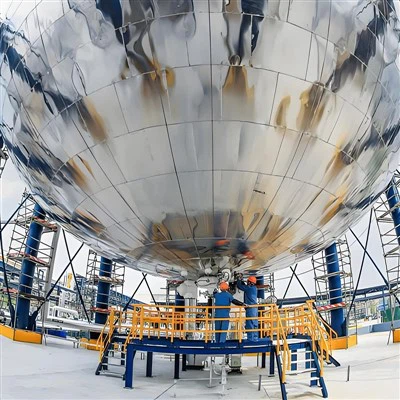
Hey there! I'm a supplier of Carbon Capture Plants, and today I wanna have a chat about how these plants stack up against other emerging carbon - capture technologies.
Let's start by getting a basic understanding of what carbon capture is all about. The whole point of carbon capture is to grab carbon dioxide (CO2) emissions before they get released into the atmosphere. This is super important because CO2 is a major greenhouse gas, and too much of it in the air is causing climate change.
Carbon Capture Plants are kind of the old - school heroes in this game. These plants are designed to capture CO2 from large - scale industrial sources like power plants, cement factories, and refineries. They work by using various chemical processes to separate CO2 from other gases. For example, one common method is using solvents that absorb CO2. Once the CO2 is absorbed, it can be separated from the solvent and stored or used for other purposes.
One of the big advantages of Carbon Capture Plants is their scale. They're built to handle huge amounts of emissions. If you've got a large industrial facility pumping out tons of CO2 every day, a Carbon Capture Plant can step in and capture a significant portion of that. It's like having a big vacuum cleaner for CO2. And because they're well - established, the technology is relatively stable. We've been using and improving these plants for a while, so we know how to make them work efficiently.
Now, let's take a look at some of the other emerging carbon - capture technologies.
Direct Air Capture (DAC) is one of the hot new things. Unlike Carbon Capture Plants that target industrial emissions, DAC technology aims to pull CO2 directly from the air. It's like a super - high - tech air filter. DAC systems use special materials that can attract and hold onto CO2 molecules. The advantage of DAC is that it can capture CO2 from anywhere, not just industrial sites. This means it can help reduce the overall CO2 levels in the atmosphere. But the downside is that it's currently pretty expensive. The concentration of CO2 in the air is very low, so you need a lot of energy and resources to capture a significant amount of it.
Another emerging technology is Bioenergy with Carbon Capture and Storage (BECCS). This one combines bioenergy production with carbon capture. The idea is to grow biomass, like trees or crops, which absorb CO2 as they grow. Then, you burn the biomass to produce energy, and at the same time, you capture the CO2 that's released during the burning process. The captured CO2 is then stored underground. BECCS has the potential to be carbon - negative, meaning it can remove more CO2 from the atmosphere than it emits. However, it also has some challenges. For example, growing large amounts of biomass requires a lot of land, water, and fertilizers. There are also concerns about the impact on food production if we start using too much land for biomass.
So, how do Carbon Capture Plants compare to these emerging technologies?
In terms of cost - effectiveness, Carbon Capture Plants often have an edge, especially when dealing with large - scale industrial emissions. Since they're designed to work with existing industrial processes, the infrastructure can be integrated relatively easily. You don't need to build a whole new system from scratch. And because of their scale, the cost per ton of CO2 captured can be lower compared to some of the emerging technologies.
When it comes to flexibility, the emerging technologies have the upper hand. DAC can be set up anywhere, which makes it great for areas where there aren't large industrial sources of CO2. And BECCS can potentially be used in rural areas where there's plenty of land for biomass production. Carbon Capture Plants, on the other hand, are tied to specific industrial facilities.
In terms of environmental impact, all of these technologies have their pros and cons. Carbon Capture Plants can help reduce the emissions from large industrial sources, which is a huge step in the right direction. But they still rely on chemical processes that may have some environmental impacts, such as the disposal of used solvents. DAC and BECCS also have their own environmental footprints, as we've discussed earlier.


If you're thinking about investing in carbon - capture solutions, it really depends on your specific needs. If you're running a large industrial facility, a Carbon Capture Plant might be the most practical choice. You can check out our Carbon Dioxide Factory and Carbon Dioxide Manufacturing Plant options. These are designed to fit different industrial requirements and can help you capture a significant amount of CO2.
If you're more interested in reducing the overall CO2 levels in the atmosphere or have a unique situation where industrial - scale capture isn't an option, you might want to look into the emerging technologies. But keep in mind that they're still evolving, and there are some uncertainties.
We also offer Carbon Removal Plant solutions that are a bit more advanced and can be customized according to your needs. Whether you're a small business looking to reduce your carbon footprint or a large corporation aiming for carbon neutrality, we've got something for you.
If you're interested in learning more about our Carbon Capture Plants or want to discuss which carbon - capture solution is right for you, don't hesitate to reach out. We're here to help you make the best decision for your business and the environment.
References
- IPCC Special Report on Carbon Dioxide Capture and Storage
- International Energy Agency (IEA) reports on carbon - capture technologies
- Scientific research papers on Direct Air Capture, Bioenergy with Carbon Capture and Storage, and Carbon Capture Plants