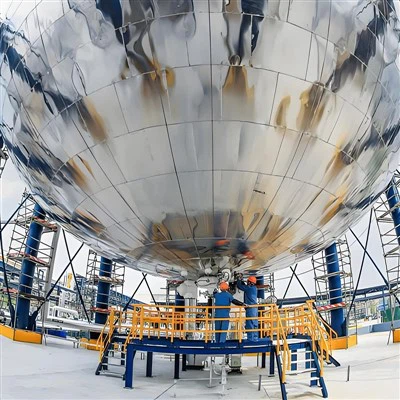
Heat transfer is a crucial aspect in a CO2 gas plant as it directly impacts the plant's efficiency, productivity, and overall operational costs. As a supplier of CO2 gas plants, I understand the significance of optimizing heat transfer processes to ensure the best performance of these facilities. In this blog post, I will share some effective strategies to improve heat transfer efficiency in a CO2 gas plant.
1. Selecting the Right Heat Exchanger
The heart of heat transfer in a CO2 gas plant is the heat exchanger. Choosing the appropriate heat exchanger is the first step in enhancing heat transfer efficiency. There are several types of heat exchangers available, such as shell - and - tube, plate - and - frame, and finned - tube heat exchangers.
Shell - and - tube heat exchangers are widely used in CO2 gas plants due to their robustness and ability to handle high pressures and temperatures. They consist of a bundle of tubes enclosed in a shell, where the CO2 gas and the heat transfer fluid flow on either side of the tubes. For applications where a large heat transfer area is required, shell - and - tube heat exchangers are an excellent choice.
Plate - and - frame heat exchangers, on the other hand, offer a higher heat transfer coefficient compared to shell - and - tube heat exchangers. They are composed of a series of plates with channels for the CO2 gas and the heat transfer fluid. The plates increase the turbulence of the fluids, which improves heat transfer. Plate - and - frame heat exchangers are more compact and require less space, making them suitable for plants with limited installation area. You can find more information about advanced heat transfer equipment in Carbon Dioxide Capture Plant.
2. Optimizing Fluid Flow Rates
The flow rate of the CO2 gas and the heat transfer fluid is another critical factor that affects heat transfer efficiency. Properly balancing the flow rates can maximize the heat transfer rate.
If the flow rate of the fluids is too low, the heat transfer process will be slow, leading to inefficient operation of the plant. On the other hand, if the flow rate is too high, it may cause excessive pressure drop, which increases the energy consumption of the pumps and fans used to circulate the fluids.

To optimize the flow rates, it is necessary to conduct detailed calculations based on the thermal properties of the CO2 gas and the heat transfer fluid, as well as the design parameters of the heat exchanger. Computational fluid dynamics (CFD) simulations can be used to model the fluid flow in the heat exchanger and determine the optimal flow rates. Regular monitoring and adjustment of the flow rates during plant operation can also ensure that the heat transfer process remains efficient.
3. Enhancing Surface Area
Increasing the surface area available for heat transfer is a straightforward way to improve heat transfer efficiency. Heat exchangers can be designed with extended surfaces, such as fins, to increase the contact area between the CO2 gas and the heat transfer fluid.
Finned - tube heat exchangers are commonly used to enhance surface area. The fins increase the area over which heat can be transferred, allowing more heat to be exchanged between the two fluids in a given time. The shape, size, and spacing of the fins also play important roles in determining the heat transfer performance. For example, well - designed fins can promote turbulence in the fluid flow, which further enhances heat transfer.
4. Minimizing Fouling
Fouling is a major problem in heat exchangers of CO2 gas plants. It refers to the deposition of unwanted substances, such as dirt, scale, and corrosion products, on the heat transfer surfaces. Fouling reduces the efficiency of heat transfer by creating a thermal resistance layer between the CO2 gas and the heat transfer fluid.
To minimize fouling, regular maintenance and cleaning of the heat exchangers are essential. Chemical cleaning agents can be used to remove the deposited substances. Additionally, pre - treatment of the CO2 gas and the heat transfer fluid can help prevent the formation of fouling. For example, filtration of the fluid can remove solid particles, and water treatment can reduce the scaling potential.
5. Improving Insulation
Proper insulation is often overlooked but is crucial for improving heat transfer efficiency in a CO2 gas plant. Insulation helps to reduce heat loss to the surroundings during the heat transfer process.
Insulating the pipes, tanks, and heat exchangers can prevent the heat from escaping. High - quality insulation materials with low thermal conductivity should be selected. The thickness of the insulation also needs to be carefully determined based on the temperature difference between the fluid and the surroundings and the allowable heat loss. By minimizing heat loss, more heat can be effectively transferred between the CO2 gas and the heat transfer fluid, improving the overall efficiency of the plant.
6. Utilizing Phase - Change Materials
Phase - change materials (PCMs) can be used to enhance heat transfer in a CO2 gas plant. PCMs can absorb and release large amounts of heat during the phase - change process (e.g., from solid to liquid or vice versa).
In a CO2 gas plant, PCMs can be incorporated into the heat exchangers or used in the thermal storage systems. During the heat transfer process, the PCM can absorb the excess heat from the CO2 gas, storing it as latent heat. When the heat is needed, the PCM can release the stored heat, providing a more stable and efficient heat transfer process. You can explore more about advanced technologies in CO2 Recovery Unit.
7. Upgrading Control Systems
Modern control systems play a vital role in optimizing heat transfer efficiency in a CO2 gas plant. Advanced sensors can be installed to monitor various parameters, such as temperature, pressure, and flow rate, in real - time.
Based on the data collected by the sensors, the control system can automatically adjust the operation of the pumps, fans, and valves to maintain the optimal heat transfer conditions. For example, if the temperature of the CO2 gas increases, the control system can increase the flow rate of the heat transfer fluid to enhance heat removal.
In conclusion, improving heat transfer efficiency in a CO2 gas plant requires a comprehensive approach that involves proper equipment selection, fluid flow optimization, surface area enhancement, fouling prevention, insulation improvement, utilization of advanced materials, and upgrading of control systems. As a supplier of CO2 gas plants, we have the expertise and experience to help our customers implement these strategies and improve the performance of their plants. If you are interested in purchasing a high - efficiency CO2 gas plant or upgrading your existing one, please feel free to contact us for a detailed discussion.
If you are also considering the recycling of CO2, our Co2 Recycling Plant offers advanced solutions to make your plant more sustainable.
References
- Incropera, F. P., DeWitt, D. P., Bergman, T. L., & Lavine, A. S. (2007). Fundamentals of Heat and Mass Transfer. John Wiley & Sons.
- Bergman, T. L., Lavine, A. S., Incropera, F. P., & DeWitt, D. P. (2011). Introduction to Heat Transfer. John Wiley & Sons.
- Stoecker, W. F. (1998). Refrigeration and Air Conditioning. McGraw - Hill.