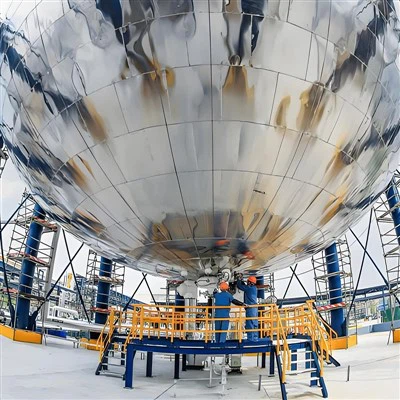
Ambient temperature plays a crucial role in the operation and performance of cryogenic Air Separation Units (ASUs). As a reputable supplier of cryogenic ASUs, we have witnessed firsthand how fluctuations in ambient temperature can have far - reaching impacts on these sophisticated systems. In this blog, we will delve into the various ways ambient temperature affects cryogenic ASUs, along with the strategies to mitigate these effects.
How Ambient Temperature Influences Cryogenic ASU Processes
Compressor Performance
The first significant effect of ambient temperature on cryogenic ASUs can be seen in the performance of the air compressor. Compressors are used to increase the pressure of the incoming air before entering the ASU. When the ambient temperature rises, the density of the air decreases. According to the ideal gas law ($PV = nRT$), for a given volume ($V$) and pressure ($P$), an increase in temperature ($T$) leads to a decrease in the number of moles ($n$) of air that the compressor can intake.


This reduction in air intake density means that the compressor has to work harder to achieve the same mass - flow rate of air into the ASU. As a result, the power consumption of the compressor increases, which not only raises operational costs but also puts more stress on the compressor components. Over time, this can lead to increased wear and tear, reducing the lifespan of the compressor and potentially causing unplanned breakdowns. On the other hand, in cold ambient conditions, the air density is higher, and the compressor may operate more efficiently with lower power consumption, but it also faces challenges such as the risk of ice formation on the intake filters and other components.
Heat Exchanger Efficiency
Heat exchangers are at the heart of cryogenic ASUs, facilitating the exchange of heat between different streams of gases to cool and liquefy the air. Ambient temperature directly affects the efficiency of these heat exchangers. In hot ambient conditions, the temperature difference between the warm and cold streams in the heat exchanger is reduced. Since the rate of heat transfer ($Q$) in a heat exchanger is proportional to the temperature difference ($\Delta T$) according to Fourier's law of heat conduction ($Q = - kA\frac{dT}{dx}$), a lower $\Delta T$ results in a decreased heat - transfer rate.
This, in turn, means that the heat exchangers may not be able to cool the incoming air effectively, leading to higher temperatures in the subsequent processes. As a consequence, more energy is required to reach the cryogenic temperatures necessary for air separation. Conversely, in cold ambient temperatures, the larger temperature difference can enhance the heat - transfer efficiency. However, extremely low temperatures can lead to issues such as freezing of moisture in the heat exchanger, which can block the passages and reduce the overall efficiency of the ASU.
Cooling Water Demand
Most cryogenic ASUs use cooling water systems to remove the heat generated during the compression and other processes. The ambient temperature has a direct impact on the cooling water demand. In hot ambient conditions, the temperature of the cooling water returning from the ASU is higher, and it takes more energy to cool it down to the required temperature for recirculation. This means that larger cooling towers or more efficient cooling systems may be needed to maintain the proper temperature of the cooling water.
Moreover, high ambient humidity associated with warm temperatures can also affect the performance of the cooling towers. Higher humidity reduces the evaporative cooling efficiency of the cooling towers, further increasing the demand for cooling water and energy. In cold ambient temperatures, the cooling water may need to be heated to prevent freezing, which also adds to the operational complexity and cost.
Impact on Product Quality and Yield
The changes in compressor performance, heat - exchanger efficiency, and cooling water demand due to ambient temperature can ultimately affect the product quality and yield of the cryogenic ASU.
Oxygen and Nitrogen Purity
The improper cooling and compression conditions caused by high or low ambient temperatures can lead to impurities in the separated oxygen and nitrogen products. For example, if the air is not cooled sufficiently due to low heat - exchanger efficiency in hot ambient conditions, some of the moisture and carbon dioxide in the air may not be removed completely during the pre - cooling and purification processes. These impurities can then enter the distillation columns and contaminate the oxygen and nitrogen products, reducing their purity.
Product Yield
The overall product yield of the cryogenic ASU can also be affected by ambient temperature. As discussed earlier, in hot ambient conditions, the compressor may not be able to deliver the required mass - flow rate of air, and the heat exchangers may not cool the air effectively. This can result in a lower amount of air being processed and separated into oxygen and nitrogen, reducing the product yield. Additionally, the energy inefficiencies associated with high ambient temperatures can make the process less cost - effective, further reducing the economic viability of the ASU.
Mitigation Strategies
As a cryogenic ASU supplier, we have developed several strategies to mitigate the impacts of ambient temperature on the performance of our ASUs.
Compressor Optimization
We recommend the use of variable - speed compressors that can adjust their speed based on the ambient temperature and air density. This allows the compressor to maintain the required mass - flow rate of air while reducing power consumption. Additionally, installing intake air chillers or pre - coolers can help lower the temperature of the incoming air in hot ambient conditions, increasing its density and improving compressor efficiency.
Heat Exchanger Design
Our ASUs are equipped with high - performance heat exchangers designed to operate efficiently across a wide range of ambient temperatures. These heat exchangers have large surface areas and advanced materials to enhance heat - transfer rates. We also recommend regular maintenance and cleaning of the heat exchangers to ensure optimal performance. In addition, employing bypass systems in the heat exchangers can help adjust the heat - transfer rate depending on the ambient temperature.
Cooling System Management
To manage the cooling water demand, we suggest the use of advanced cooling systems such as hybrid cooling towers that can adapt to different ambient conditions. These cooling towers can combine evaporative and dry cooling methods to optimize the cooling process and reduce water consumption. Installing temperature sensors and control systems in the cooling water circuits can also help maintain the appropriate water temperature, preventing freezing in cold conditions and overheating in hot conditions.
Conclusion
In conclusion, ambient temperature has a significant impact on the performance, product quality, and yield of cryogenic ASUs. As a [Company - without - name] cryogenic ASU supplier, we understand the challenges posed by different ambient temperatures and have developed comprehensive solutions to address them. Our advanced technologies and experienced team are committed to providing our customers with cryogenic ASUs that can operate efficiently and reliably in various environmental conditions.
If you are interested in our Gas Cryogenic Air Separation Plant, Liquid Air Separation Plant or Cryogenic Air Separation Nitrogen, we invite you to contact us for more information and to discuss your specific requirements. Our team of experts will be more than happy to assist you in selecting the most suitable cryogenic ASU for your application.
References
- Ruthven, D. M. (1984). Principles of Adsorption and Adsorption Processes. John Wiley & Sons.
- Young, D. A. (1989). Phase Equilibria in Metals and Ceramics. University of California Press.
- Green, D. W., & Perry, R. H. (2007). Perry's Chemical Engineers' Handbook. McGraw - Hill.