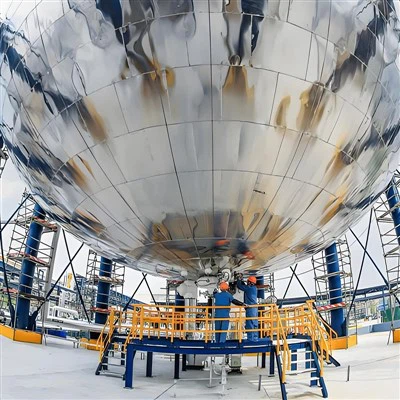
As a leading supplier of Co2 Production Plant, I've witnessed firsthand the remarkable complexity and potential of carbon dioxide production facilities. These plants are not just about generating CO2; they also yield a variety of by - products that are valuable in different industries. In this blog, I'll delve into the by - products of a CO2 production plant and their applications.
Water Vapor
One of the most common by - products of a CO2 production plant is water vapor. During the process of CO2 production, especially when it involves combustion or chemical reactions that generate CO2, water is often formed as a result. For example, in a natural gas - fired CO2 production process, the combustion of methane (CH4) with oxygen (O2) produces carbon dioxide and water according to the following chemical equation: CH4 + 2O2 → CO2+ 2H2O.
The water vapor can be condensed and collected. In some cases, this water can be of relatively high purity, especially if the production process uses clean feedstocks. This condensed water can be used in various non - potable applications within the plant itself, such as for cooling systems or in certain chemical processes where water is required as a solvent or reactant. It can also be treated further for reuse in other industrial applications or even for irrigation in some cases, provided it meets the necessary quality standards.
Nitrogen
In many CO2 production plants, air is used as a source of oxygen for combustion or other chemical reactions. Air is composed mainly of nitrogen (about 78%) and oxygen (about 21%), along with small amounts of other gases. When air is used in the production process, the nitrogen present in the air remains largely unreacted and can be separated from the CO2.
Nitrogen has a wide range of industrial applications. It is commonly used as an inert gas in the food and beverage industry to prevent oxidation and spoilage. For example, nitrogen is often used to flush packaging of chips, nuts, and other snack foods to displace oxygen and extend the shelf - life of the products. In the electronics industry, nitrogen is used in soldering and other manufacturing processes to prevent oxidation of sensitive components. It is also used in the chemical industry as a blanketing gas in storage tanks to prevent the formation of explosive mixtures.
Argon
Argon is another noble gas that is present in air in small amounts (about 0.93%). Similar to nitrogen, argon remains unreacted during the CO2 production process when air is used as a feedstock. Argon can be separated from the other gases in the plant's output stream.
Argon has several important applications. In the welding industry, argon is used as a shielding gas to protect the weld area from oxidation and contamination. It provides a stable arc and helps to produce high - quality welds. In the lighting industry, argon is used in incandescent and fluorescent light bulbs to improve the efficiency and lifespan of the bulbs. It is also used in the semiconductor industry for various processes, such as in the growth of single - crystal silicon for microchips.
Heat
The process of CO2 production often involves exothermic reactions, which release a significant amount of heat. This heat can be considered a valuable by - product. In some CO2 production plants, the heat generated can be recovered and used for various purposes.
For example, the heat can be used to pre - heat feedstocks before they enter the main reaction vessels, which can improve the energy efficiency of the production process. It can also be used for space heating within the plant or for heating water for other industrial processes. In some cases, the excess heat can be sold to nearby facilities, such as district heating systems or other industrial plants that require heat for their operations. This not only reduces the overall energy consumption of the CO2 production plant but also provides an additional source of revenue.
Chemical Residues
Depending on the feedstocks and production processes used in a CO2 production plant, there may be various chemical residues left behind. For example, if the plant uses fossil fuels as a feedstock, there may be small amounts of sulfur compounds, particulate matter, and other contaminants in the output stream. These residues need to be removed from the CO2 product to meet quality standards.
However, some of these residues can be further processed and used. For instance, sulfur compounds can be converted into sulfuric acid, which is a widely used industrial chemical. Sulfuric acid is used in the production of fertilizers, in the petroleum industry for refining, and in many other chemical manufacturing processes. Particulate matter can sometimes be used in construction materials or in other applications where fine particles are required.
Hydrogen
In some advanced CO2 production processes, such as those based on electrolysis or certain chemical reforming reactions, hydrogen can be produced as a by - product. For example, in a process where water is electrolyzed to produce oxygen for use in the CO2 production reaction, hydrogen is also generated at the cathode.
Hydrogen has significant potential as an energy carrier. It can be used in fuel cells to generate electricity with high efficiency and low emissions. In the transportation sector, hydrogen fuel cell vehicles are being developed as a clean alternative to traditional gasoline and diesel vehicles. Hydrogen can also be used in the chemical industry as a reducing agent in various chemical reactions, such as in the production of ammonia and methanol.
Economic and Environmental Benefits of By - products
The by - products of a CO2 production plant offer both economic and environmental benefits. Economically, the sale or reuse of these by - products can provide an additional source of revenue for the plant. For example, selling nitrogen, argon, or heat to other industries can offset the production costs of CO2. It can also make the overall operation of the plant more profitable and competitive in the market.
Environmentally, the reuse of by - products reduces waste and the need for additional resource extraction. For example, using the condensed water from the plant for cooling or other industrial applications reduces the demand for fresh water. The use of nitrogen and argon as inert gases in various industries reduces the need for other chemicals that may be more harmful to the environment. Additionally, the recovery and use of heat from the production process reduces the consumption of fossil fuels for heating purposes, thereby reducing greenhouse gas emissions.
Conclusion
As a supplier of Co2 Manufacturing Plant and Co2 Gas Plant, I understand the importance of not only producing high - quality CO2 but also maximizing the value of the by - products generated in the process. The by - products of a CO2 production plant, such as water vapor, nitrogen, argon, heat, chemical residues, and hydrogen, have a wide range of applications in different industries.


If you are interested in learning more about our CO2 production plants and how they can efficiently produce CO2 while also maximizing the recovery and utilization of by - products, we invite you to contact us for a procurement discussion. We are committed to providing you with the most advanced and efficient solutions for your CO2 production needs.
References
- Perry, R. H., & Green, D. W. (1997). Perry's Chemical Engineers' Handbook. McGraw - Hill.
- Coker, A. K. (2001). Handbook of Refinery Processing. Gulf Professional Publishing.
- Kirk - Othmer Encyclopedia of Chemical Technology. Wiley.