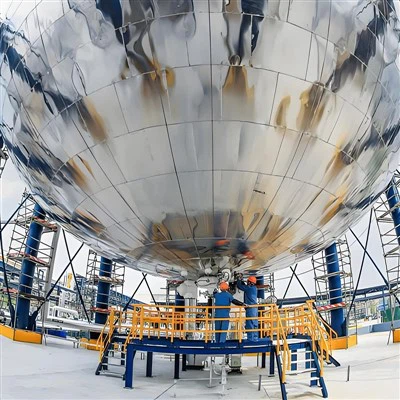
Hey there! As a supplier of CO2 liquefaction plants, I've seen firsthand the wide variety of these plants out there. Today, I'm gonna break down the differences between different types of CO2 liquefaction plants.
Basic Principles of CO2 Liquefaction
Before we dive into the types, let's quickly go over how CO2 liquefaction works. CO2 is a gas at normal atmospheric conditions. To turn it into a liquid, we need to lower its temperature and increase the pressure. The basic idea is to get the CO2 molecules closer together so they form a liquid state.
Different Types of CO2 Liquefaction Plants
CO2 Purification and Liquefaction Plants
These plants are all about cleaning up the CO2 before liquefying it. The raw CO2 source can have all sorts of impurities like water, nitrogen, oxygen, and hydrocarbons. CO 2 Purification and Liquefaction Plants use different methods to remove these impurities.
One common method is adsorption. Special materials are used to attract and hold onto the impurities, leaving behind relatively pure CO2. Another method is distillation, where the different components are separated based on their boiling points. Once the CO2 is purified, it goes through the liquefaction process. These plants are great when the raw CO2 source is dirty and you need high - purity liquid CO2. For example, in the food and beverage industry, where CO2 is used for carbonating drinks, high - purity CO2 is a must.
CO2 Recovery and Liquefaction Plants
CO 2 Recovery and Liquefaction Plants focus on capturing CO2 from waste streams. There are many industrial processes that produce CO2 as a by - product, like fermentation in breweries, ammonia production, and cement manufacturing. Instead of letting this CO2 go into the atmosphere, these plants capture it and turn it into liquid CO2.
The recovery part involves using techniques like absorption, where a liquid solvent is used to dissolve the CO2 from the gas stream. After that, the CO2 is separated from the solvent and then liquefied. These plants are not only good for the environment by reducing greenhouse gas emissions but also make economic sense. The recovered and liquefied CO2 can be sold for various applications, such as in the refrigeration industry or for enhanced oil recovery.


Carbon Dioxide Liquefaction Plant
Carbon Dioxide Liquefaction Plant is a more general term. It can refer to a plant that takes relatively pure CO2 and simply liquefies it. Maybe the CO2 source is already fairly clean, like from a natural CO2 well. These plants usually focus on the liquefaction process itself.
There are different liquefaction cycles used in these plants. One of the most common is the Joule - Thomson cycle. In this cycle, high - pressure CO2 gas is allowed to expand through a valve. This expansion causes the temperature of the CO2 to drop, and if the conditions are right, it will turn into a liquid. Another cycle is the cascade refrigeration cycle, which uses multiple refrigerants with different boiling points to cool the CO2 step - by - step until it liquefies.
Key Differences
Feedstock Requirements
The feedstock for CO2 purification and liquefaction plants can be very impure. They are designed to handle a wide range of impurities and still produce high - quality liquid CO2. CO2 recovery and liquefaction plants deal with waste gas streams, so the composition of the feedstock can vary greatly depending on the industrial process. On the other hand, carbon dioxide liquefaction plants typically require a relatively pure CO2 feedstock, which simplifies the process.
Process Complexity
CO2 purification and liquefaction plants are quite complex because of the purification step. They need multiple units for impurity removal, which adds to the cost and maintenance requirements. CO2 recovery and liquefaction plants also have a complex process, especially the recovery part. Capturing CO2 from waste streams can be challenging due to the low concentration of CO2 and the presence of other gases. Carbon dioxide liquefaction plants, when dealing with pure feedstock, have a relatively simpler process, mainly focusing on the liquefaction cycle.
Product Purity
The product purity of CO2 purification and liquefaction plants is usually very high, often meeting strict industry standards. This is important for applications where purity matters, like in the pharmaceutical or food industries. CO2 recovery and liquefaction plants can also produce high - purity CO2, but it depends on the efficiency of the recovery and purification steps. Carbon dioxide liquefaction plants produce liquid CO2 with a purity that is mainly determined by the purity of the feedstock.
Energy Consumption
All types of CO2 liquefaction plants consume energy, but the amount can vary. CO2 purification and liquefaction plants may consume more energy due to the purification processes, which often involve heating and cooling steps. CO2 recovery and liquefaction plants also use a significant amount of energy for the recovery process, especially if the CO2 concentration in the waste stream is low. Carbon dioxide liquefaction plants, with a simpler process, may have relatively lower energy consumption, especially if an efficient liquefaction cycle is used.
Why Choose Our CO2 Liquefaction Plants
As a supplier, we've designed our plants to be efficient, reliable, and cost - effective. Whether you need a CO2 purification and liquefaction plant for high - purity applications, a CO2 recovery and liquefaction plant to capture waste CO2, or a simple carbon dioxide liquefaction plant for pure feedstock, we've got you covered.
Our plants are built with the latest technology and high - quality materials. We understand that every customer has different needs, so we offer customized solutions. We also provide excellent after - sales service, including maintenance, troubleshooting, and spare parts supply.
If you're in the market for a CO2 liquefaction plant, we'd love to have a chat with you. We can help you figure out which type of plant is best for your specific situation, and we'll work with you to make sure you get the most out of your investment. Don't hesitate to reach out and start the procurement discussion.
References
- "Carbon Dioxide Capture and Storage" by IPCC
- "Industrial Gas Processing: Technology and Engineering" by various authors