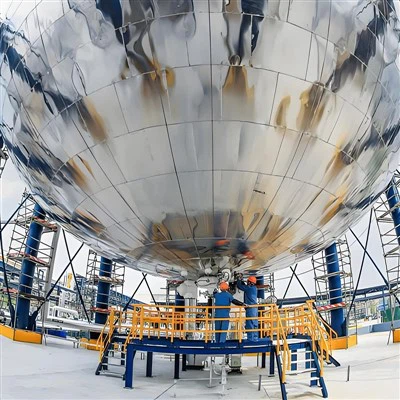
As a trusted supplier of CO2 processing plants, I am often asked about the distillation processes involved in these facilities. Distillation is a crucial step in the production of high - purity CO2, and understanding these processes can help potential customers make informed decisions when considering investing in a CO2 Recovery And Production Plants. In this blog post, I will delve into the various distillation processes used in a CO2 processing plant, explaining their principles, advantages, and applications.
1. Introduction to Distillation in CO2 Processing
Distillation is a separation technique based on the differences in the boiling points of the components in a mixture. In a CO2 processing plant, the raw feedstock often contains a mixture of CO2 and other impurities such as nitrogen, oxygen, water, and hydrocarbons. The goal of distillation is to separate CO2 from these impurities to produce a high - purity product that meets the requirements of various industries, including food and beverage, medical, and industrial applications.
2. Simple Distillation
Simple distillation is the most basic form of distillation and is suitable for separating mixtures with large differences in boiling points. In a CO2 processing context, simple distillation can be used as an initial step to remove some of the gross impurities.
The principle of simple distillation is relatively straightforward. The mixture is heated in a distillation flask, and the component with the lower boiling point vaporizes first. The vapor then travels up the distillation column and is condensed in a condenser back into a liquid, which is collected in a receiving flask.
However, simple distillation has its limitations. For a CO2 mixture, the differences in boiling points between CO2 and some of the impurities may not be large enough to achieve high - purity separation using simple distillation alone. Additionally, if the mixture contains close - boiling components, simple distillation will not be able to separate them effectively.
3. Fractional Distillation
Fractional distillation is a more advanced and commonly used method in CO2 processing plants. It is designed to separate mixtures where the components have relatively close boiling points.
3.1 Principle of Fractional Distillation
Fractional distillation uses a fractionating column, which provides multiple stages of condensation and vaporization. As the vapor rises through the fractionating column, it comes into contact with the cooler surfaces of the column packing. Components with higher boiling points condense on the packing and flow back down the column, while components with lower boiling points continue to rise as vapor. This process is repeated multiple times within the column, allowing for a more precise separation of the components in the mixture.
3.2 Advantages in CO2 Processing
In a CO2 processing plant, fractional distillation can be used to separate CO2 from other gases such as nitrogen and oxygen. CO2 has a boiling point of - 78.5 °C at standard pressure, while nitrogen boils at - 195.8 °C and oxygen at - 183 °C. By carefully controlling the temperature and pressure within the fractionating column, the plant can achieve a high - purity separation of CO2.
Furthermore, fractional distillation can also be used to remove trace amounts of hydrocarbons and other impurities from the CO2 stream. These impurities can affect the quality of the final CO2 product, and fractional distillation provides an effective way to meet the strict purity requirements of different industries.
4. Vacuum Distillation
Vacuum distillation is another important distillation technique used in CO2 processing plants, especially when dealing with heat - sensitive components or when lower boiling points are desired.
4.1 How Vacuum Distillation Works
In vacuum distillation, the pressure within the distillation system is reduced below atmospheric pressure. According to the Clausius - Clapeyron equation, the boiling point of a liquid decreases as the pressure decreases. By applying a vacuum, the boiling points of the components in the CO2 mixture are lowered, which reduces the energy required for vaporization and also minimizes the risk of thermal degradation of the components.
4.2 Applications in CO2 Processing
In a CO2 processing plant, vacuum distillation can be used to separate CO2 from water. Water has a relatively high boiling point at atmospheric pressure, but by reducing the pressure, it can be vaporized and separated from CO2 at a lower temperature. This is particularly useful when the raw feedstock contains significant amounts of water, as it helps to prevent the formation of ice or other solid deposits that could clog the distillation equipment.
5. Azeotropic Distillation
Azeotropic distillation is a specialized distillation method used when the mixture forms an azeotrope, a mixture of two or more components that has a constant boiling point and composition. In the context of CO2 processing, azeotropic distillation may be required to separate CO2 from certain impurities that form azeotropes with CO2.
5.1 Principle of Azeotropic Distillation
Azeotropic distillation involves the addition of a third component, known as an entrainer, to the mixture. The entrainer forms a new azeotrope with one of the components in the original mixture, which allows for the separation of the components by distillation.
5.2 Challenges and Solutions in CO2 Processing
The use of azeotropic distillation in CO2 processing can be challenging, as the selection of the entrainer is critical. The entrainer must have the right properties to form a suitable azeotrope and should be easily separable from the CO2 and other components after the distillation process. Additionally, the use of an entrainer may introduce new impurities into the system, which requires further purification steps.
6. Cryogenic Distillation
Cryogenic distillation is a highly efficient method for producing high - purity CO2. It is based on the principle of cooling the gas mixture to very low temperatures, where different components condense at different temperatures.
6.1 Process of Cryogenic Distillation
In a cryogenic distillation process for CO2, the feed gas is first compressed and then cooled to very low temperatures using a refrigeration system. As the temperature drops, the components with higher boiling points, such as CO2, condense first and are separated from the remaining gases. The condensed CO2 is then further purified through additional distillation steps to achieve the desired purity level.
6.2 Advantages in CO2 Production
Cryogenic distillation offers several advantages in CO2 processing. It can produce CO2 with extremely high purity, often exceeding 99.9%. This high - purity CO2 is suitable for a wide range of applications, including the food and beverage industry, where strict purity requirements must be met. Additionally, cryogenic distillation can handle large - scale production, making it suitable for commercial applications.
7. Applications of Different Distillation Processes in CO2 Processing Plants
Different distillation processes are used in different stages of a Co2 Manufacturing Plant depending on the characteristics of the raw feedstock and the desired purity of the final CO2 product. For example, simple distillation may be used as a pre - treatment step to remove large - scale impurities, while fractional distillation is often used for the main separation of CO2 from other gases. Vacuum distillation can be employed to remove water and heat - sensitive impurities, and cryogenic distillation is reserved for the production of high - purity CO2.


8. Conclusion and Call to Action
In conclusion, the distillation processes in a CO2 processing plant are diverse and complex, but each plays a crucial role in producing high - quality CO2. As a leading supplier of Commercial CO2 Capture Plant, we have the expertise and technology to design and build CO2 processing plants that utilize the most suitable distillation processes for your specific needs. Whether you are in the food and beverage industry, the medical field, or other industries that require high - purity CO2, we can provide you with a customized solution.
If you are interested in learning more about our CO2 processing plants or would like to discuss your specific requirements, please do not hesitate to contact us. We look forward to the opportunity to work with you and provide you with the best CO2 processing solutions.
References
- Perry, R. H., & Green, D. W. (1997). Perry's Chemical Engineers' Handbook. McGraw - Hill.
- Kohl, A. L., & Nielsen, R. B. (1997). Gas Purification. Gulf Publishing Company.