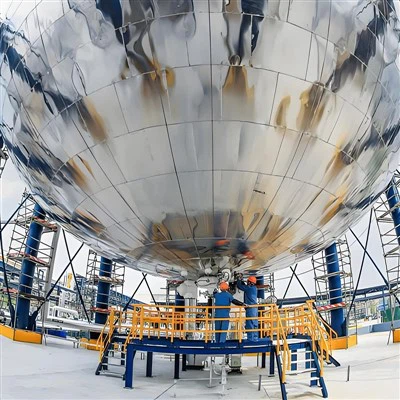
Process intensification techniques play a crucial role in enhancing the efficiency, productivity, and sustainability of a CO2 recovery plant. As a leading supplier of CO2 recovery plants, we have been at the forefront of implementing and innovating these techniques to provide our customers with state - of - the - art solutions. In this blog, we will explore the various process intensification techniques employed in a CO2 recovery plant.
1. Absorption - based Intensification
Absorption is one of the most common methods for CO2 recovery. In a traditional absorption process, CO2 is absorbed into a liquid solvent, and then the solvent is regenerated to release the captured CO2.
Advanced Solvents
The choice of solvent is critical in the absorption process. Advanced solvents with high CO2 absorption capacity, fast reaction kinetics, and low regeneration energy requirements can significantly improve the process efficiency. For example, some new amine - based solvents have been developed that can capture CO2 more effectively than traditional monoethanolamine (MEA). These solvents can reduce the energy consumption during the regeneration step, which is often the most energy - intensive part of the absorption process.
Packed Column Design
Packed columns are widely used in absorption processes. Process intensification can be achieved through optimized packed column design. High - performance packing materials with large surface areas and good mass - transfer characteristics can enhance the contact between the gas and the liquid phases, leading to more efficient CO2 absorption. Additionally, structured packings can be used to improve the flow distribution within the column, reducing the chances of channeling and improving the overall mass - transfer efficiency. For instance, Sulzer Mellapak structured packing has been shown to provide excellent mass - transfer performance in CO2 absorption columns.
2. Membrane - based Intensification
Membrane separation is an emerging technology for CO2 recovery. It offers several advantages such as low energy consumption, compact design, and easy scale - up.
High - performance Membranes
The development of high - performance membranes is crucial for efficient CO2 separation. These membranes should have high CO2 permeability and selectivity over other gases. For example, polymers such as polyimides and polycarbonates have been used to fabricate membranes with good CO2 separation properties. Additionally, mixed - matrix membranes, which combine polymers with inorganic fillers, can further enhance the membrane performance by improving the CO2 permeability and selectivity.
Membrane Module Design
The design of membrane modules also plays an important role in process intensification. Spiral - wound and hollow - fiber membrane modules are commonly used. Optimized module design can improve the flow distribution of the gas and the permeate, reducing the concentration polarization effect and enhancing the overall separation efficiency. For example, in a hollow - fiber membrane module, proper fiber packing density and flow channel design can ensure uniform gas flow and efficient CO2 separation.
3. Adsorption - based Intensification
Adsorption is another method for CO2 recovery. In this process, CO2 is adsorbed onto a solid adsorbent, and then the adsorbent is regenerated to release the CO2.
Novel Adsorbents
The development of novel adsorbents with high CO2 adsorption capacity, fast adsorption kinetics, and good regeneration properties is essential for process intensification. Metal - organic frameworks (MOFs) are a class of promising adsorbents for CO2 capture. They have large surface areas and tunable pore structures, which can be designed to selectively adsorb CO2. Additionally, activated carbons and zeolites can also be modified to improve their CO2 adsorption performance.


Adsorption Bed Design
The design of the adsorption bed can significantly affect the adsorption process. Multi - bed adsorption systems can be used to achieve continuous CO2 recovery. For example, a pressure - swing adsorption (PSA) system typically consists of multiple adsorption beds that operate in a cyclic manner. By optimizing the bed size, flow rate, and cycle time, the PSA system can achieve high - efficiency CO2 separation.
4. Process Integration
Process integration is an important process intensification technique that involves combining different unit operations in a CO2 recovery plant to improve the overall efficiency.
Heat Integration
Heat integration can be used to reduce the energy consumption in a CO2 recovery plant. For example, the heat released during the CO2 desorption process can be used to pre - heat the feed gas or the solvent in the absorption process. This can significantly reduce the external energy input required for the process.
Hybrid Processes
Hybrid processes that combine different separation technologies can also be employed for process intensification. For example, a membrane - absorption hybrid process can take advantage of the high selectivity of membranes and the high capacity of absorption processes. In this hybrid process, the membrane can be used as a pre - separation step to remove a large portion of the CO2, and then the remaining CO2 can be further captured by the absorption process.
5. Equipment Design and Optimization
The design and optimization of equipment in a CO2 recovery plant can also contribute to process intensification.
Compact Equipment
Compact equipment design can reduce the footprint of the CO2 recovery plant, making it more suitable for on - site installation. For example, compact heat exchangers such as plate - fin heat exchangers can be used to achieve efficient heat transfer in a small space. Additionally, modular equipment design can facilitate the rapid installation and commissioning of the plant.
Automation and Control
Automation and control systems can be used to optimize the operation of the CO2 recovery plant. Real - time monitoring of process parameters such as temperature, pressure, and flow rate can ensure the stable and efficient operation of the plant. Advanced control algorithms can be used to adjust the operating conditions in response to changes in the feed gas composition and flow rate, maximizing the CO2 recovery efficiency.
As a CO2 recovery plant supplier, we are committed to providing our customers with the most advanced process intensification solutions. Our Carbon Dioxide Capture Plant is designed with the latest technologies and techniques to ensure high - efficiency CO2 recovery. Our Co2 Recycling Plant can not only capture CO2 but also recycle it for various applications, contributing to a more sustainable future. And our Co2 Factory is a comprehensive solution that integrates all the process intensification techniques to provide a turn - key CO2 recovery solution.
If you are interested in our CO2 recovery plant solutions or want to discuss your specific requirements, we encourage you to contact us for a detailed procurement discussion. We have a team of experts who can provide you with professional advice and customized solutions to meet your needs.
References
- Merkel, T. C., et al. "Mixed matrix membranes for CO2 separation." Journal of Membrane Science 378.1 - 2 (2011): 11 - 23.
- Sircar, S., and T. A. Golden. "Pressure swing adsorption." Adsorption 1.1 (1995): 203 - 229.
- Rochelle, G. T. "Amine scrubbing for CO2 capture." Science 325.5948 (2009): 1652 - 1654.