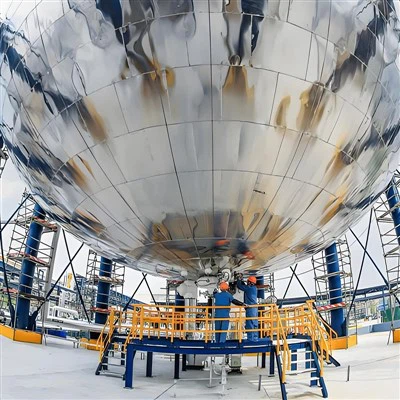
In the realm of industrial gas production, cryogenic oxygen plants stand as a cornerstone for various sectors, from healthcare to manufacturing. As a seasoned supplier of cryogenic oxygen plants, I've witnessed firsthand the critical role these facilities play in meeting the ever - growing demand for high - purity oxygen. One of the most crucial components within a cryogenic oxygen plant is the distillation column. In this blog, I'll delve into the functions of the distillation column in a cryogenic oxygen plant and explain why it's indispensable for producing high - quality oxygen.
Understanding the Basics of Cryogenic Oxygen Plants
Before we dive into the details of the distillation column, let's briefly understand how a cryogenic oxygen plant operates. A cryogenic oxygen plant separates air into its primary components, mainly oxygen, nitrogen, and argon, through a process called cryogenic distillation. This process takes advantage of the different boiling points of these gases at extremely low temperatures.
The raw material for a cryogenic oxygen plant is air. First, the air is filtered to remove dust and other particulates. Then, it is compressed and cooled to very low temperatures, usually below - 170°C. At these low temperatures, the air turns into a liquid, which can then be separated into its individual components.


The Central Role of the Distillation Column
The distillation column is the heart of a cryogenic oxygen plant. Its primary function is to separate the liquid air into its main components: oxygen, nitrogen, and argon. This separation is based on the differences in their boiling points. Oxygen has a boiling point of - 183°C, nitrogen boils at - 196°C, and argon boils at - 186°C.
Fractionation Process
The distillation column works on the principle of fractionation. Liquid air enters the distillation column at a specific point. Inside the column, there are multiple trays or packing materials that provide a large surface area for the liquid and vapor to interact. As the liquid air moves down the column, it is heated slightly, causing the more volatile components (with lower boiling points) to vaporize.
Nitrogen, being the most volatile component, vaporizes first and rises to the top of the column. At the top, it is collected as a high - purity nitrogen product. Oxygen, on the other hand, is less volatile and tends to stay in the liquid phase. It accumulates at the bottom of the column and is drawn off as a high - purity oxygen product. Argon, with a boiling point between that of oxygen and nitrogen, accumulates in a section of the column between the oxygen - rich and nitrogen - rich regions.
Multiple Column Configurations
In many cryogenic oxygen plants, there are multiple distillation columns used in series to achieve a higher degree of separation. For example, a double - column system is commonly used. The first column, known as the low - pressure column, separates the liquid air into a nitrogen - rich vapor at the top and an oxygen - rich liquid at the bottom. The oxygen - rich liquid from the low - pressure column is then fed into a second column, where further purification takes place to produce high - purity oxygen.
Ensuring High - Purity Oxygen Production
The distillation column is designed to produce oxygen with a very high purity level. In most industrial applications, oxygen purity of 99.5% or higher is required. The design and operation of the distillation column are critical to achieving this level of purity.
Tray and Packing Design
The trays or packing materials inside the distillation column are carefully designed to maximize the contact between the liquid and vapor phases. This ensures efficient mass transfer between the two phases, which is essential for achieving a high degree of separation. The number of trays or the height of the packing can be adjusted based on the desired purity of the oxygen product.
Temperature and Pressure Control
Precise control of temperature and pressure inside the distillation column is also crucial for producing high - purity oxygen. The temperature profile along the column is carefully maintained to ensure that the separation process occurs as efficiently as possible. Pressure control helps to maintain the stability of the column operation and also affects the boiling points of the gases.
Energy Efficiency Considerations
As a cryogenic oxygen plant supplier, I understand the importance of energy efficiency. The distillation column plays a significant role in the overall energy consumption of the plant.
Heat Integration
Modern distillation columns are designed with heat integration in mind. The heat released during the condensation of the vapor at the top of the column can be used to pre - heat the incoming liquid air or to provide heat for other parts of the plant. This reduces the overall energy requirements of the plant.
Optimized Operation
Proper operation of the distillation column is essential for energy efficiency. This includes maintaining the correct liquid and vapor flow rates, as well as optimizing the temperature and pressure profiles. Advanced control systems are often used to monitor and adjust these parameters in real - time, ensuring that the column operates at its most efficient level.
Applications of Cryogenic Oxygen Plants
The high - purity oxygen produced by cryogenic oxygen plants has a wide range of applications.
Healthcare Industry
In the healthcare industry, high - purity oxygen is used for respiratory therapy, anesthesia, and in intensive care units. The reliability and purity of the oxygen produced by cryogenic oxygen plants are crucial for patient safety.
Metal Manufacturing
In the metal manufacturing industry, oxygen is used in processes such as steelmaking and welding. The high - purity oxygen helps to increase the efficiency of these processes and improve the quality of the final products.
Chemical Industry
The chemical industry also relies on high - purity oxygen for various chemical reactions. For example, oxygen is used in the production of ethylene oxide, which is a key raw material for the production of plastics and detergents.
Our Offerings as a Cryogenic Oxygen Plant Supplier
As a supplier of cryogenic oxygen plants, we offer a range of products to meet the diverse needs of our customers. Our Cryogenic Liquid Oxygen Plant is designed for large - scale production of liquid oxygen, which can be stored and transported easily. Our Cryogenic Oxygen Generator is suitable for smaller - scale applications where a continuous supply of high - purity oxygen is required. And our Cryogenic Liquid Oxygen Gas Plant combines the advantages of both liquid and gas oxygen production.
Contact Us for Procurement and Consultation
If you are in the market for a cryogenic oxygen plant or need more information about our products and services, we invite you to reach out to us. Our team of experts is ready to assist you in choosing the right solution for your specific requirements. Whether you are a small - scale user or a large industrial enterprise, we have the expertise and experience to provide you with a high - quality and efficient cryogenic oxygen plant.
References
- Kohl, A. L., & Nielsen, R. B. (1997). Gas Purification. Gulf Publishing Company.
- Perry, R. H., & Green, D. W. (1997). Perry's Chemical Engineers' Handbook. McGraw - Hill.
- Walas, S. M. (1985). Chemical Process Equipment: Selection and Design. Butterworth - Heinemann.