Hey there! As a supplier of air separation plants, I often get asked about how these amazing machines work. So, I thought I'd take a few minutes to break it down for you in a way that's easy to understand.
First off, let's talk about what an air separation plant actually does. Simply put, it takes in air from the atmosphere and separates it into its main components: nitrogen, oxygen, and argon. These gases have a wide range of applications in various industries, from healthcare to manufacturing.


Now, let's dive into the working principle of an air separation plant. The process can be divided into several key steps, and I'll walk you through each one.
Step 1: Air Intake and Filtration
The first step in the process is to draw in air from the surrounding environment. This is usually done using a large compressor, which sucks in air and increases its pressure. Before the air enters the compressor, it passes through a series of filters to remove any dust, dirt, or other contaminants. This is important because these impurities can damage the equipment and affect the quality of the separated gases.
Step 2: Compression and Cooling
Once the air is filtered, it enters the compressor, where its pressure is increased significantly. Compressing the air also raises its temperature, so it needs to be cooled down before it can be further processed. This is typically done using a heat exchanger, which transfers the heat from the compressed air to a cooling medium, such as water or refrigerant.
Step 3: Purification
After the air is compressed and cooled, it goes through a purification process to remove any remaining impurities, such as carbon dioxide, water vapor, and hydrocarbons. This is usually done using adsorbent beds, which contain materials that can selectively trap these contaminants. The purified air is then ready for the next step.
Step 4: Cryogenic Distillation
The heart of the air separation process is cryogenic distillation. In this step, the purified air is cooled to extremely low temperatures, typically below -170°C (-274°F), using a series of heat exchangers and expansion turbines. At these low temperatures, the air turns into a liquid, and the different components of the air have different boiling points. This allows them to be separated using a distillation column.
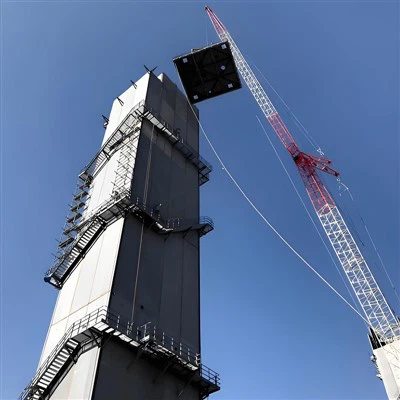
The distillation column is a tall, vertical vessel that contains a series of trays or packing materials. The liquid air is fed into the top of the column, and as it flows down through the trays or packing, it is heated by a reboiler at the bottom of the column. The heat causes the liquid to vaporize, and the different components of the air vaporize at different rates. The lighter components, such as nitrogen, rise to the top of the column, while the heavier components, such as oxygen and argon, collect at the bottom.
Step 5: Product Extraction
Once the different components of the air are separated in the distillation column, they can be extracted as products. The nitrogen gas is usually taken from the top of the column, while the oxygen and argon are taken from the bottom. The products can be further purified and processed depending on their intended use.
Step 6: Storage and Distribution
After the products are extracted, they are stored in tanks or cylinders for later use. The storage tanks are designed to keep the gases at the appropriate pressure and temperature to ensure their quality and safety. The gases can then be distributed to customers using pipelines, trucks, or other transportation methods.
So, that's the basic working principle of an air separation plant. It's a complex process that requires a lot of specialized equipment and expertise, but it's also a very efficient way to produce high-purity nitrogen, oxygen, and argon.
As a supplier of air separation plants, we offer a wide range of products and services to meet the needs of our customers. Whether you're looking for a small, modular plant for a laboratory or a large, industrial-scale plant for a chemical factory, we have the expertise and experience to provide you with the right solution.
If you're interested in learning more about our air separation plants or have any questions about the working principle, please don't hesitate to contact us. We'd be happy to discuss your requirements and provide you with a customized quote.
In addition to our standard air separation plants, we also offer ASU Nitrogen And Oxygen Supply For Chemical Industry, which are specifically designed to meet the needs of the chemical industry. These plants are capable of producing high-purity nitrogen and oxygen at large volumes, making them ideal for use in chemical processes such as ammonia synthesis, methanol production, and ethylene oxide production.
We also offer Air Separation Plant and Liquid Oxygen And Nitrogen Plant, which are designed to produce liquid oxygen and nitrogen for a variety of applications, including healthcare, food processing, and metal fabrication.
So, if you're in the market for an air separation plant or need a reliable supplier of nitrogen, oxygen, or argon, look no further. Contact us today to learn more about our products and services and how we can help you meet your gas supply needs.
References
- Kohl, A. L., & Nielsen, R. B. (1997). Gas Purification. Gulf Publishing Company.
- Perry, R. H., & Green, D. W. (1997). Perry's Chemical Engineers' Handbook. McGraw-Hill.
- Walas, S. M. (1985). Chemical Process Equipment: Selection and Design. Butterworth-Heinemann.