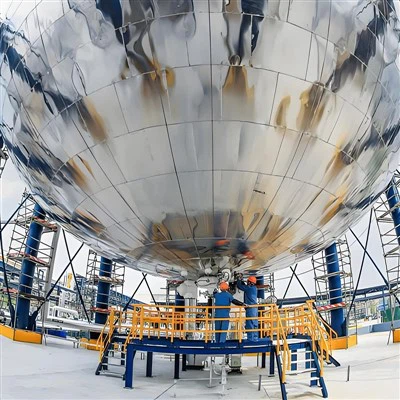
Yo, folks! I'm stoked to chat with you today about the super cool world of cryogenic equipment. As a supplier of this high - tech gear, I've seen firsthand how it's making waves in a bunch of different industries. So, let's dive right in and check out the many applications of cryogenic equipment.
1. Air Separation
One of the most common uses of cryogenic equipment is in air separation. Air is made up of different gases like nitrogen, oxygen, and argon, and cryogenic technology helps us separate these gases for various industrial needs.


The Gas Cryogenic Air Separation Plant and Cryogenic Air Separation Unit are the key players here. They work by cooling air to extremely low temperatures, around - 170°C to - 200°C. At these frigid temperatures, the different gases in the air condense at different points. For example, oxygen liquefies at about - 183°C, nitrogen at - 196°C, and argon at - 186°C.
Once the gases are liquefied, they can be easily separated using distillation columns. The separated gases have a wide range of applications. Oxygen is used in steelmaking, chemical production, and medical applications. In steelmaking, oxygen is blown into the furnace to react with carbon and other impurities, helping to produce high - quality steel. In the medical field, oxygen is essential for patients with breathing problems.
Nitrogen, on the other hand, is used for food preservation, electronics manufacturing, and as an inert gas in chemical reactions. It helps to prevent oxidation and spoilage in food products. In electronics manufacturing, nitrogen is used to create a clean, oxygen - free environment to prevent the oxidation of sensitive components.
Argon is used in welding and as a shielding gas in the semiconductor industry. In welding, argon creates a protective atmosphere around the weld, preventing the metal from reacting with oxygen and nitrogen in the air, which can cause defects in the weld.
2. Liquefied Natural Gas (LNG) Industry
The LNG industry is another major area where cryogenic equipment plays a crucial role. Natural gas is mainly composed of methane, and to transport it efficiently over long distances, it needs to be liquefied. Cryogenic equipment is used to cool natural gas to about - 162°C, at which point it turns into a liquid.
The advantage of liquefying natural gas is that it reduces its volume by about 600 times. This makes it much easier and more cost - effective to store and transport. Specialized cryogenic storage tanks and shipping vessels are used to keep the LNG at its low temperature during storage and transportation.
Once the LNG reaches its destination, it needs to be regasified before it can be used. Again, cryogenic equipment is involved in this process. The LNG is gradually warmed up, and the gas is then distributed through pipelines for use in power generation, heating, and as a fuel for vehicles.
3. Medical and Biotechnology
In the medical and biotech fields, cryogenic equipment is used for a variety of purposes. One of the most important applications is in cryopreservation. This is the process of storing cells, tissues, and organs at extremely low temperatures to preserve their viability for future use.
For example, sperm, eggs, and embryos can be cryopreserved for fertility treatments. Stem cells, which have the potential to develop into different types of cells in the body, are also cryopreserved for research and therapeutic purposes. Cryogenic freezers are used to maintain the samples at temperatures as low as - 196°C, which effectively stops all biological activity and preserves the samples for long periods.
Another application in the medical field is cryosurgery. In cryosurgery, extremely cold temperatures are used to destroy abnormal tissues, such as tumors. Special cryogenic probes are used to deliver liquid nitrogen or argon gas to the target area, freezing and killing the unwanted cells. This is a minimally invasive alternative to traditional surgery in some cases.
4. Superconductivity
Superconductivity is a phenomenon where certain materials can conduct electricity with zero resistance when cooled below a critical temperature. This critical temperature is usually very low, often in the range of - 200°C or lower.
Cryogenic equipment is essential for maintaining these low temperatures. Superconducting materials have a wide range of potential applications, including high - speed trains, magnetic resonance imaging (MRI) machines, and power transmission.
In high - speed trains, superconducting magnets can be used to create a magnetic levitation (maglev) effect, allowing the train to float above the tracks and reduce friction, which enables the train to reach extremely high speeds.
In MRI machines, superconducting magnets generate a strong magnetic field, which is used to create detailed images of the inside of the human body. The use of superconducting magnets allows for more powerful and precise imaging compared to traditional magnets.
In power transmission, superconducting cables can carry electricity with very little loss, which could significantly improve the efficiency of the power grid.
5. Food Industry
The food industry also benefits from cryogenic equipment. Cryogenic freezing is a popular method for preserving food products. By using liquid nitrogen or carbon dioxide, food can be frozen very quickly.
Rapid freezing helps to preserve the quality of the food by minimizing the formation of ice crystals. Large ice crystals can damage the cell structure of the food, leading to a loss of texture and flavor. With cryogenic freezing, the food is frozen so fast that only small ice crystals form, which helps to maintain the original quality of the food.
Cryogenic equipment is also used in the production of some food products. For example, in the production of ice cream, cryogenic freezing can be used to create a smoother and creamier texture.
6. Aerospace
In the aerospace industry, cryogenic equipment is used in rocket propulsion systems. Liquid oxygen (LOX) and liquid hydrogen are commonly used as rocket fuels. These fuels need to be stored and handled at extremely low temperatures.
Cryogenic storage tanks are used to keep the LOX and liquid hydrogen in their liquid state. When the rocket is launched, the cryogenic fuels are pumped into the combustion chamber, where they react to produce a large amount of thrust. The use of cryogenic fuels allows rockets to achieve higher performance and carry heavier payloads compared to other types of fuels.
As you can see, cryogenic equipment has a wide range of applications across different industries. Whether it's separating gases, preserving food, or powering rockets, this technology is making a big impact.
If you're in the market for Cryogenic Equipment, we've got you covered. We're a leading supplier of high - quality cryogenic equipment, and we can provide you with the solutions you need. Whether you need a small cryogenic freezer for a medical lab or a large - scale air separation plant for an industrial facility, we have the expertise and the products to meet your requirements.
If you're interested in learning more or discussing your specific needs, don't hesitate to reach out to us. We'd love to have a chat with you and see how we can help you with your cryogenic equipment needs.
References
- Perry, R. H., & Green, D. W. (Eds.). (1997). Perry's Chemical Engineers' Handbook. McGraw - Hill.
- Cengel, Y. A., & Boles, M. A. (2015). Thermodynamics: An Engineering Approach. McGraw - Hill.
- Kirk - Othmer Encyclopedia of Chemical Technology. (2004). Wiley - Interscience.