Hey there! As a supplier of liquid oxygen plants, I'm super excited to take you on a journey through the main components of these amazing facilities. Liquid oxygen plants are crucial in various industries, from healthcare to metal fabrication, so understanding their components is essential. Let's dive right in!
Air Compressor
The first major component of a liquid oxygen plant is the air compressor. Think of it as the heart of the system. Its job is to suck in ambient air and compress it to a much higher pressure. This compression is vital because it increases the density of the air, making it easier to separate the different gases later on.
There are different types of air compressors used in liquid oxygen plants, such as reciprocating compressors and centrifugal compressors. Reciprocating compressors are great for small to medium-sized plants. They work by using pistons to compress the air in a cylinder. Centrifugal compressors, on the other hand, are more suitable for large-scale operations. They use a rotating impeller to accelerate the air and then convert the kinetic energy into pressure energy.
Air Purifier
Once the air is compressed, it's far from pure. It contains all sorts of impurities like dust, water vapor, carbon dioxide, and hydrocarbons. That's where the air purifier comes in. This component is like a super-efficient filter that removes these unwanted substances from the compressed air.
The most common method of air purification in liquid oxygen plants is adsorption. Adsorption beds filled with special materials like molecular sieves are used to trap the impurities. Molecular sieves have tiny pores that can selectively adsorb different molecules based on their size and shape. For example, they can trap water vapor and carbon dioxide while allowing oxygen and nitrogen to pass through.
Heat Exchanger
After the air is purified, it needs to be cooled down to extremely low temperatures. This is where the heat exchanger plays a crucial role. A heat exchanger is a device that transfers heat between two fluids without them mixing.
In a liquid oxygen plant, the heat exchanger cools the incoming purified air by exchanging heat with the cold outgoing gases. This is a very efficient process that helps to conserve energy. There are different types of heat exchangers used, such as plate-fin heat exchangers and shell-and-tube heat exchangers. Plate-fin heat exchangers are commonly used because they have a large surface area for heat transfer, which makes them very efficient.
Distillation Column
The distillation column is the key component for separating oxygen from nitrogen. It works based on the principle of fractional distillation. Different gases have different boiling points, and the distillation column takes advantage of this property to separate them.
The cold, purified air enters the distillation column at the bottom. As it rises through the column, it encounters a series of trays or packing materials. The trays or packing provide a large surface area for the gases to interact. The nitrogen, which has a lower boiling point than oxygen, vaporizes and rises to the top of the column, while the oxygen, which has a higher boiling point, condenses and collects at the bottom.
Liquid Oxygen Storage Tank
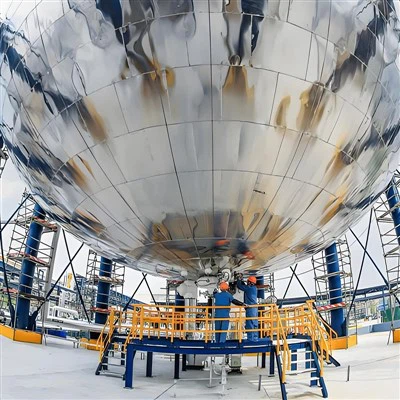
Once the oxygen is separated and liquefied, it needs to be stored safely. That's the job of the liquid oxygen storage tank. These tanks are designed to keep the liquid oxygen at a very low temperature and under pressure.
The storage tanks are usually made of stainless steel or other materials that can withstand the low temperatures and high pressures. They are also insulated to minimize heat transfer from the outside environment. This helps to keep the liquid oxygen in a stable state for a long time.
Control System
Last but not least, every liquid oxygen plant needs a reliable control system. The control system is like the brain of the plant. It monitors and controls all the processes in the plant to ensure that everything runs smoothly and safely.
The control system uses sensors to measure various parameters like temperature, pressure, flow rate, and oxygen purity. Based on these measurements, it can adjust the operation of the different components of the plant. For example, if the temperature in the distillation column is too high, the control system can adjust the flow of the cooling medium to bring the temperature down.


Now that you know the main components of a liquid oxygen plant, you might be interested in building one for your business. If so, check out our Liquid Oxygen Plant Build page for more information. We also have a wide range of Oxygen Liquid Plant options available to suit your specific needs. And if you're looking for a Liquid Oxygen Manufacturing Plant, we've got you covered too.
If you're interested in purchasing a liquid oxygen plant or have any questions about our products, don't hesitate to get in touch with us. We're always happy to help you find the best solution for your business.
References
- Perry, R. H., & Green, D. W. (1997). Perry's Chemical Engineers' Handbook. McGraw-Hill.
- Kohl, A. L., & Nielsen, R. B. (1997). Gas Purification. Gulf Publishing Company.